The Origin, 14 July 2026
There is a scientific paper published in the American Journal of Medicine called "The Autopsy of Chicken Nuggets Reads 'Chicken Little.'"
That is a real title. Written by real doctors. Published in a real medical journal. And it is exactly as disturbing as it sounds.
Dr. Richard deShazo wanted to know what was inside a chicken nugget.
He's a professor at the University of Mississippi Medical Center. He'd read the reports about what fast food nuggets actually contain. He didn't believe them. So he did what any good scientist does. He bought some nuggets, took them to his lab, sliced them open, stained them, and put them under a microscope.
"I was floored," he said. "I was astonished actually seeing it under the microscope."
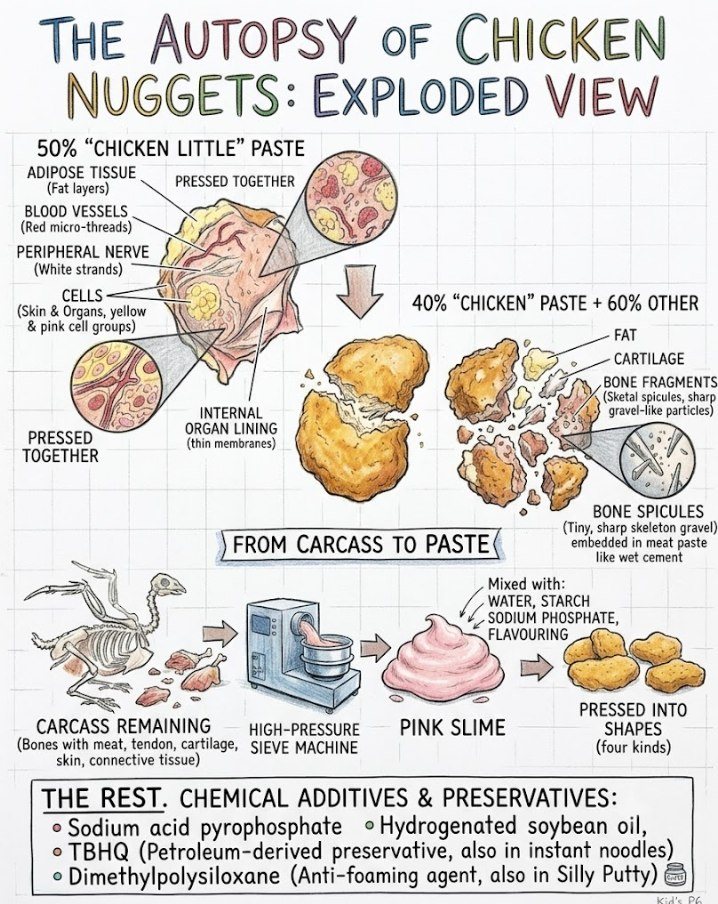
The first nugget was about 50 percent chicken.
That sounds okay until you ask what the other 50 percent was.
Fat, blood vessels, and nerves. Cells from the skin and internal organs of the chicken. Under the microscope, deShazo could see it all. Layers of adipose tissue. Strands of peripheral nerve. The lining of the chicken's internal organs. Pressed together, battered, fried, and shaped into something your child dips into sweet and sour sauce.
The second nugget was worse. 40 percent chicken. The rest? Fat, cartilage, and fragments of bone.
Not ground bone. Not powdered bone. Bone spicules. Tiny, sharp pieces of skeleton visible under a microscope, embedded in the meat paste like gravel in wet cement.
deShazo put it plainly. Some companies, he said, have chosen to use "an artificial mixture of chicken parts" rather than actual white meat, batter it, fry it, and call it chicken.
To understand how this happens, you need to know what happens to a chicken after the good parts are gone.
After the breasts, thighs, wings, and drumsticks have been cut away, a carcass remains. Bones with scraps of meat still clinging to them. Bits of tendon. Cartilage. Skin. Connective tissue. This is the part most people would throw away.
The industry doesn't throw it away.
The carcass goes into a machine. The machine forces it through a sieve under high pressure. The soft tissue squeezes through. The hard bone stays behind. Mostly.
What comes out the other side is a paste. A pink, smooth, batter-like paste. The USDA calls it "mechanically separated poultry." The internet calls it pink slime. It is made of whatever was too stubborn to fall off the skeleton and too soft to resist the sieve.
This paste is the base of your nugget. It gets mixed with water, starch, sodium phosphate, and flavouring. Then it gets pressed into shapes (McDonald's famously uses exactly four), battered, fried, frozen, and shipped to a restaurant, where it gets fried a second time.
By the time it reaches your child's tray, it has been processed so many times that it no longer resembles any part of the animal it came from.
That's the point. It's not supposed to remind you of a chicken. It's supposed to remind you of a shape.
The word "chicken" is doing a lot of work in "chicken nugget."
If you read the ingredients list on a bag of frozen nuggets, or on the wall of a fast food chain, you'll find far more than chicken. Sodium acid pyrophosphate. Hydrogenated soybean oil. TBHQ, the same petroleum-derived preservative that shows up in instant noodles. Some brands have used dimethylpolysiloxane, an anti-foaming agent for the frying oil. It is also an ingredient in Silly Putty.
A few major chains have cleaned up their recipes in recent years, removing some additives under public pressure. But the mechanically separated chicken underneath hasn't changed. The process is the same. The paste is the same. The bone spicules are the same.
This is the food that fast food companies market to children. Happy Meals. Dino shapes. Fun dipping sauces. Cartoon characters on the box. The packaging is designed to make a child want it. The ingredients are designed to make sure no one reads the back.
Americans eat about 2.3 billion pounds of chicken nuggets per year.
That's roughly 50 billion individual nuggets. Nearly all of them consumed without a single thought about what's inside. In Singapore, every mall food court, every McDonald's, every frozen food aisle at FairPrice sells them. Kids eat them at birthday parties, in school canteens, and as after-school snacks.
Nobody asks what's inside. The shape doesn't invite the question. A nugget doesn't look like a wing or a thigh or a drumstick. It doesn't look like any part of a chicken at all. And that's not an accident.
Dr. deShazo has grandchildren. They ask for nuggets.
He doesn't say no. He just doesn't buy the fast food version. He takes a chicken breast, cuts it into pieces, coats them in a little flour, and pan-fries them in oil. Same shape. Same crunch. Actual chicken.
I tried the same thing last week. Trinity ate four pieces. She didn't notice the difference. Or maybe she did, and just didn't say anything.
The nugget on her plate was chicken. Just chicken. No bone spicules, no peripheral nerve, no pink paste squeezed through a sieve.
Just a piece of bird, cooked by her dad, who made the mistake of reading a paper called "The Autopsy of Chicken Nuggets."
Some papers you can't unread.