
The Origin, 1 August 2026
To order a cup of coffee in Singapore, you need at least three languages. And you have about four seconds to do it.
Walk into any kopitiam and listen...
The customer ahead of you will say something like "kopi-C siew dai peng." Six syllables.
Under two seconds. And without realising it, they've just used words drawn from Malay and at least three southern Chinese dialect groups in a single breath.
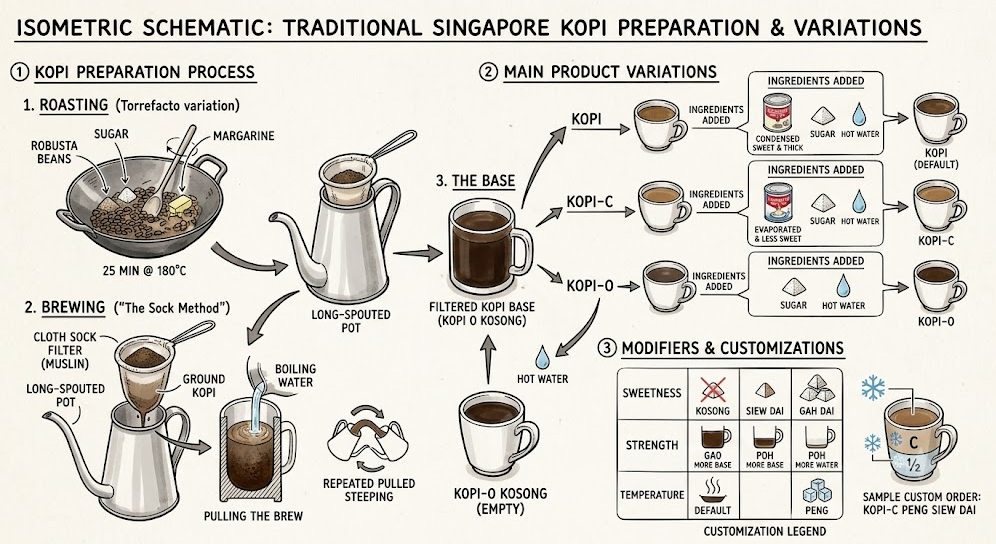
Kopi is Malay for coffee, borrowed from the Dutch word koffie. The C is commonly explained either as a reference to the Hainanese word for "fresh" milk or to Carnation, the evaporated milk brand that's been used since the colonial era.
Nobody has settled the argument. Siew dai means less sweet, though its precise dialect origin is disputed... Cantonese and Foochow influence are both plausible. Peng is Hokkien for ice.
These aren't four separate languages being switched between. They're something more Singaporean than that: words borrowed from different communities, worn smooth by decades of daily use until they became a shared vocabulary that belongs to no single dialect and all of them.
The uncle behind the counter doesn't need a menu. He doesn't need you to repeat it. He heard you, and he's already reaching for the sock.
Yes. The sock.
The coffee is brewed through a cloth filter made of muslin or flannel, shaped like a large sock stretched over a metal frame. Cloth filtration was already common in colonial Southeast Asia... cheap, reusable, and practical for high-volume coffee stalls. It needed no electricity and could serve hundreds of cups a day. Over a hundred years later, it's still there.
A cloth filter allows more of the bean's natural oils and fine particles into the cup than most paper filters do. That's what gives kopi its distinctively thick body and smooth finish.
But the real invention is what happens to the beans before they reach it.
Singapore's kopi is made primarily from Robusta beans. Robusta has long been treated as the less prestigious species in the coffee world... more bitter, more body, roughly twice the caffeine of Arabica, but historically considered to lack its subtlety. A growing Fine Robusta movement is challenging that assumption, but for most of the last century, Robusta was simply the cheap one. It's also the bean that grows well in tropical Southeast Asia.
In the early 20th century, Hainanese immigrants who'd worked as cooks and servants in British colonial households began opening their own coffee shops. They'd learned European-style coffee brewing in colonial kitchens. But as regional coffee production shifted toward cheaper, hardier Robusta, and as the Hainanese operators couldn't match the price of imported Arabica, they adapted.
They roasted the beans in a wok with sugar, margarine, and salt.
Roasting methods vary from shop to shop.
At Kim Guan Guan, one of Singapore's traditional roasting houses, a single batch takes about 45 minutes. The green beans go into the wok first, dry, at around 240°C. For the first 35 minutes, the roaster listens. There's a specific sequence of crackling that tells an experienced ear when the beans are done. You can't learn it from a manual. You learn it the way every kopi roaster before you learned it: by standing over that wok until your ears know what your eyes can't tell you.
Then the beans are poured into a wok of melted sugar.
A cloud of white vapour erupts as moisture evaporates.
The roaster tosses the batch to coat every bean and adds margarine to separate the sticky, caramelised beans as they cool. Other roasters work at lower temperatures for shorter durations. The ratio of beans to sugar and margarine is typically around eight to two by weight, but no two shops do it exactly the same way.
The roasting develops the beans' own Maillard-reaction compounds... the browning, the roasted aromas, the hundreds of new flavour molecules that heat creates from amino acids and sugars. The external sugar caramelises around the bean and produces that dark, toffee-like sweetness kopi is known for. The margarine contributes richness and also keeps the coated beans from fusing into a solid block as they cool.
Some roasters also add maize to reduce costs.
Over time, its roasted flavour became part of the profile customers associated with traditional Nanyang coffee.
Not all kopi contains it, but in the blends that do, it's no longer filler. It's part of the taste.
And then there's the milk.
Fresh milk spoils fast in equatorial heat. In the decades before widespread refrigeration, keeping it cold in Singapore was expensive and impractical. Condensed milk was shelf-stable, cheap, and sweet enough to counter whatever bitterness the wok roast hadn't already tamed.
So the standard kopi uses condensed milk. Kopi-C swaps it for evaporated milk. Kopi-O drops the milk entirely and adds sugar. Kopi-O kosong goes all the way. Black coffee, no sugar, no milk. Kosong is Malay for "empty."
From there, you adjust strength: gao for strong, poh for weak. Sweetness: siew dai for less, gah dai for more. Temperature: peng for iced. Concentration: di lo, Hokkien for "straight down," meaning undiluted, poured directly from the sock. Multiply the modifiers and you can construct dozens of combinations. Every regular has a signature order the kopitiam uncle has already memorised.
The system was built by immigrants adapting European coffee to Southeast Asian crops, climate, budgets, and tastes.
Hainanese immigrants arrived in Singapore later than the Hokkien, Teochew, and Cantonese communities, who'd already claimed the better trades. The Hainanese took what was left: domestic service. They became cooks, valets, and household servants for the British colonials.
When that work diminished, they turned the skills they'd picked up in colonial kitchens into a livelihood. Foochow operators joined them.
The kopitiams they opened became the social infrastructure of working-class Singapore. By 1927, records counted 195 Hainanese-run coffee shops alone. By the 1950s, the island had more than 2,000.
Every technique that defines kopi was an answer to a specific problem.
Beans too bitter, so they caramelised them in sugar.
Milk too perishable, so they used condensed. They couldn't afford imported brewing equipment, which is how a cloth filter on a metal frame became the standard. And when customers needed it cheap as well as strong, the economics shaped the recipe as much as the taste did. Each constraint forced an adaptation. And the adaptations, layered over decades by Hainanese, Foochow, and other operators, produced something no single community could have designed alone.
The next time you're standing at a kopitiam counter, listen to the person in front of you. They'll rattle off something short and clipped. Five syllables, maybe six.
What you're hearing is words borrowed from Malay, Hokkien, Cantonese, Foochow, and possibly Hainanese, worn smooth by generations of daily use. Behind them sits a century of migration, regional agriculture, colonial kitchens, and constant adjustment.
And the uncle already has his hand on the sock.