The Origin, 2 August 2026
Every time you flush a toilet in Singapore, your waste disappears. You don't hear it. You don't smell it. You have no idea where it goes.
But it goes somewhere extraordinary.
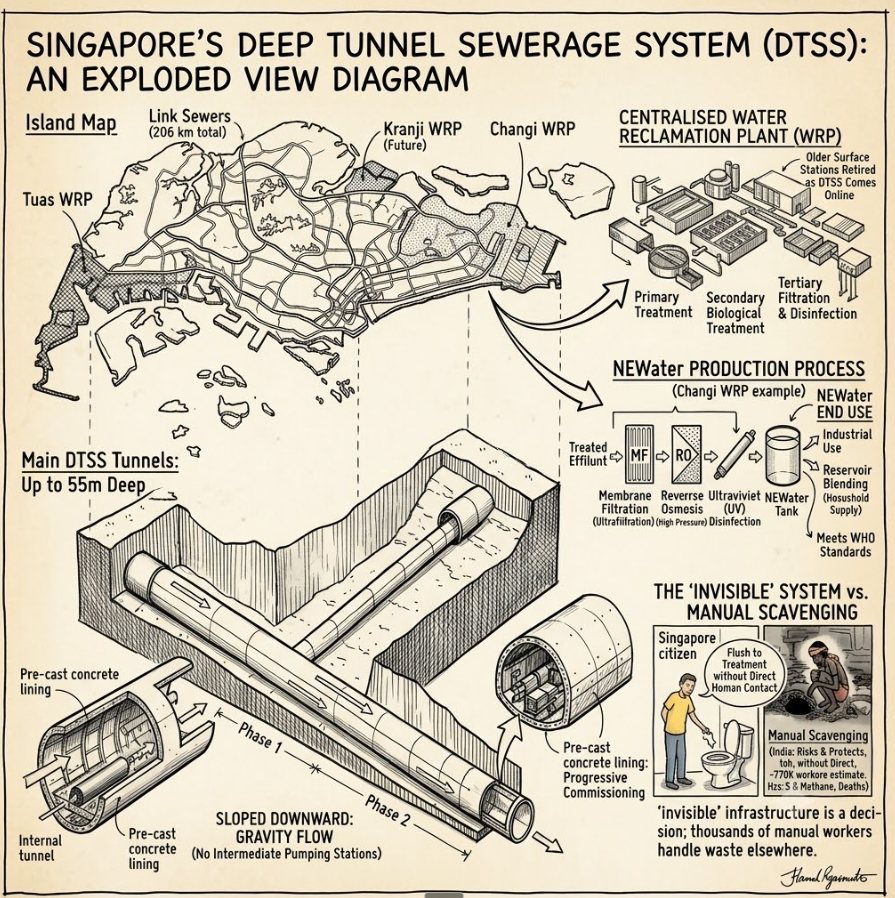
55 metres beneath the city, deeper than most MRT tunnels, a network of sewage tunnels slopes gently downward. The used water flows through them by gravity alone, no intermediate pumping stations needed along the route, toward centralised treatment plants on the coast.
The system is called the Deep Tunnel Sewerage System.
When fully completed, it will span 206 kilometres of tunnels and link sewers carrying sanitary wastewater from every toilet, sink, and household fixture on the island.
PUB started building it in the late 1990s. It still isn't finished.
Phase 1 was completed in 2008. Tunnelling for Phase 2 finished in 2023, though the full network, including the new Tuas Water Reclamation Plant, won't be commissioned until 2027. Changi is already operating. Tuas is under construction. Kranji will follow.
Changi WRP was initially designed to treat 800,000 cubic metres of used water a day. That's about 320 Olympic swimming pools. Its capacity has since expanded to around a million.
But here's the part that stops people mid-sentence.
Part of the treated effluent is sent to a NEWater factory, where it undergoes membrane filtration, reverse osmosis, and ultraviolet disinfection. The rest is safely discharged to the sea.
The NEWater that comes out the other end consistently meets WHO and US EPA drinking water standards. Singapore has built enough NEWater capacity to meet a substantial share of national demand, mostly for industrial use, with a portion blended into reservoirs.
Singapore recycles its sewage into drinkable water.
And the entire process, under normal operation, happens inside enclosed pipes, tunnels, and treatment machinery. Maintenance crews inspect and repair the system. But day to day, your waste moves from flush to treatment without direct human contact.
Under normal operations, nobody needs to handle the raw waste directly.
Now hold that sentence in your head, because in a moment it's going to mean something different.
India's government surveys have identified 58,098 people who clean human waste by hand.
That's the official number, counted under the legal definition of manual scavenger... those who clean latrines, open drains, and railway tracks by hand. Separately, the NAMASTE programme had validated nearly 90,000 sewer and septic-tank workers by mid-2026. The Safai Karmachari Andolan, India's largest anti-manual-scavenging movement, puts the broader sewer-cleaning workforce at around 770,000.
The numbers are contested. The deaths are not.
Between January 2017 and September 2018, one worker died while cleaning sewers or septic tanks roughly every five days.
That figure, compiled by the National Commission for Safai Karamcharis from incomplete district reports, was considered conservative. Between 2021 and mid-2026, the government recorded 332 more killed during hazardous cleaning. The advocacy group DASAM documented at least 55 deaths between February and June 2026 alone. Activists say even these numbers undercount the real toll, because deaths are routinely misclassified and families sometimes pressured into quiet settlements.
The practice has been banned twice.
In 1993, and again more comprehensively in 2013, under a law that also prohibits hazardous cleaning without required protective equipment. Over the five years ending mid-2026, 193 criminal complaints were registered against agencies and officials.
The deaths didn't stop.
And the way they die makes it worse.
A worker is lowered into a manhole or septic tank. In many documented cases, they have no breathing apparatus, no gas detector, no harness or gloves. Sometimes no shoes.
Sewers and septic tanks produce hydrogen sulfide and methane. Hydrogen sulfide is denser than air. It pools at the bottom of confined spaces. At low concentrations, it smells like rotten eggs. At higher concentrations, it rapidly fatigues or paralyses the sense of smell, so you stop detecting it right as the danger intensifies.
At very high concentrations, collapse can occur within one or two breaths and death within minutes.
Then there is the pattern that keeps repeating. A worker enters and collapses from gas exposure. A second goes in to pull them out and also collapses. A third follows. Chain-reaction confined-space deaths. Across India, three or four people have died this way in a single incident, each trying to save the person who went in before them.
And then there's the question nobody asks loudly enough: who are these workers?
In a government survey of urban sewer and septic-tank workers, roughly 92 percent came from Scheduled Caste, Scheduled Tribe, or Other Backward Class communities. About 68 percent were Scheduled Caste. For many families, caste discrimination, poverty, and exclusion make sanitation work intergenerational. Genuine occupational choice is severely restricted.
There is one more dimension that almost never enters the conversation.
In its research on communities still practising dry-latrine cleaning, Human Rights Watch estimated that women performed about 95 percent of the work, carrying loads of human waste on their heads. The sewer deaths make the news because they're sudden and public. The women doing this work accumulate health consequences over years, in silence.
This is not a comparison between a country with sewage infrastructure and one without it.
India has sewers, treatment plants, and mechanisation programmes. Singapore has a near-universal centralised system built over decades at a cost of billions, serving a compact city-state of six million. India is an enormous federal country of 1.4 billion where coverage, enforcement, and worker protection remain deeply uneven.
But the contrast still stands.
In Singapore, enclosed tunnels and automated treatment mean that used water moves from source to plant with minimal human contact. In parts of India, a worker enters a hole in the ground. They breathe gas that can kill them in minutes. They clean the waste with their hands. And if they die, the contractor who sent them in may never face prosecution.
Remember the sentence from earlier?
Nobody touches it. Nobody has to.
That's Singapore. It's also supposed to be India. The law says so. Twice.
The infrastructure in Singapore is invisible because it works.
The people who do this work in India are invisible because nobody wants to see them.
You flushed a toilet this morning. You didn't think about where it went.
That's not luck. That's a decision someone made, decades ago, that no human being in this country should ever have to handle another person's waste.
India made that same decision in law. The continuing deaths show how far implementation still falls short.