The Origin, 8 July 2026
There are more bubble tea shops in Singapore than there are 7-Elevens.
More than there are McDonald's, Starbucks, and KFC locations combined, most likely.
You can find one in every MRT station, every mall, and every neighbourhood centre.
You probably walked past 3 of them today.
You may have stopped at one.
You may be holding a cup right now, pulling balls of tapioca through a fat straw while reading this on your phone.
If you are, I need to tell you what's in it.
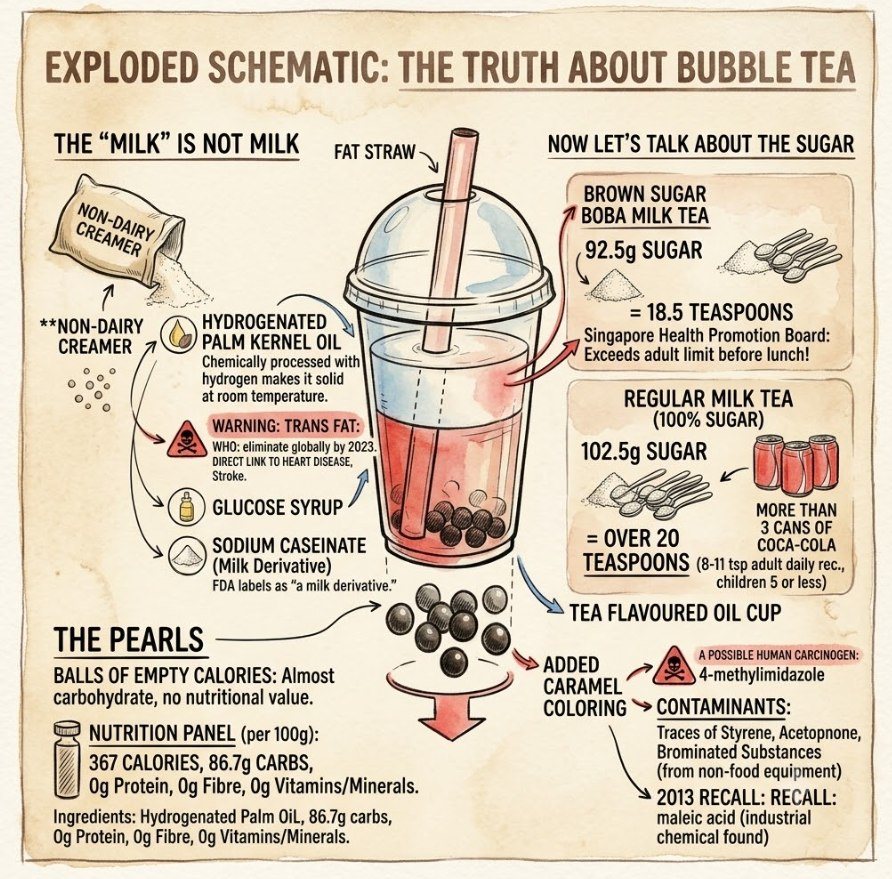
Let's start with the "milk."
Many bubble tea shops don't use milk.
They use non-dairy creamer.
It comes as a white powder in large bags. The main ingredient is hydrogenated palm kernel oil. That's a vegetable oil that's been chemically processed with hydrogen gas to make it solid at room temperature.
When that oil is partially hydrogenated, the result is trans fat.
The kind of fat that the World Health Organisation has asked every country to eliminate from its food supply because it is directly linked to heart disease and stroke. Mount Alvernia Hospital in Singapore has specifically flagged this: non-dairy creamer in bubble tea can contain trans fat in the form of hydrogenated palm oil.
Your "milk tea" is not milk.
It is not tea with milk.
It is tea flavoured with a powder made from processed palm oil, glucose syrup, and a milk protein called sodium caseinate that the FDA requires to be labelled as "a milk derivative." Some shops use fresh milk. Many don't. And the ones that don't are selling you a cup of oil that looks like milk and tastes close enough that you can't tell the difference.
Now let's talk about the sugar.
A study by Temasek Polytechnic in Singapore, commissioned by CNA, tested 6 popular brands of bubble tea. A brown sugar boba milk tea contained 92.5 grams of sugar. That's 18.5 teaspoons. In a single cup.
Singapore's Health Promotion Board recommends 8 to 11 teaspoons of sugar per day for adults. Five or fewer for children.
One cup of brown sugar boba exceeds the adult daily limit.
Before you've had lunch. Before you've counted the sugar in your coffee, your kopi, or the kaya on your toast. And this doesn't include the sugar in the pearls. The study only measured the liquid.
A regular bubble milk tea ordered at 100% sugar measured even worse. 102.5 grams. Over 20 teaspoons. Nearly three cans of Coca-Cola. In one cup.
If you order the large size, the numbers climb higher still.
Now the pearls.
The balls you're chewing are made from tapioca starch.
Tapioca starch comes from the cassava root.
It is almost entirely carbohydrate. A hundred grams of it contains 367 calories and 86.7 grams of carbs. It has no protein, no fibre, and no vitamins or minerals worth mentioning.
You're chewing empty calories shaped into spheres.
The brown or black colour comes from brown sugar or caramel colouring. Some producers use food-grade caramel that contains 4-methylimidazole, a compound classified by the International Agency for Research on Cancer as a possible human carcinogen. Not every brand uses it. But the colour of your pearls isn't natural. It's added.
In 2012, German researchers at the University Hospital Aachen tested tapioca pearls from a Taiwanese chain.
They found traces of styrene and acetophenone, chemicals typically found in plastics, not food. They also found brominated substances that are not permitted as food additives. The researchers noted these were likely contaminants from non-food-grade packaging or processing equipment.
The findings were not published in a peer-reviewed journal, and the amounts were not specified. But the fact that tyre-adjacent chemicals showed up in a food product sold to millions of people raised enough concern that Singapore's food authority acted. In 2013, Singapore recalled tapioca pearls from bubble tea shops after 11 kinds of Taiwanese tapioca products were found to contain maleic acid, an industrial chemical used in the production of resins and plastics.
Bubble tea was invented by accident in the 1980s.
The most common origin story goes like this. In 1988, at a teahouse called Chun Shui Tang in Taichung, Taiwan, a product manager named Lin Hsiu Hui poured her tapioca dessert into her iced tea during a staff meeting. She was bored. Or curious. Or both. The other staff tried it. They loved it. It went on the menu.
A rival teahouse in Tainan, the Hanlin Tea Room, claims it invented bubble tea in 1986 using white tapioca pearls.
The two shops argued about it for decades.
A Taiwanese court eventually ruled that nobody could claim ownership of the invention. Bubble tea belonged to everyone.
And now everyone drinks it. The global bubble tea market was valued at nearly $3 billion in 2025 and is projected to keep climbing. In Singapore, where the average temperature sits above 30 degrees year-round, cold, sweet drinks are not a luxury. They're a reflex. You finish lunch. You buy boba. You don't think about it.
But maybe you should think about it. Just once.
One cup.
Hydrogenated palm oil pretending to be milk.
Nearly 20 teaspoons of sugar before lunch.
Balls of pure starch with no nutritional value. Possible traces of industrial chemicals depending on your supplier. Caramel colouring that may or may not contain a possible carcinogen.
And the really strange part?
Even knowing all of this, you'll probably still order one tomorrow.
I would too, honestly. It's delicious.
That's the problem with bubble tea. It's not that it's bad. It's that it's so good you don't ask what's in it.
Nobody ever does. They just drink.