The Origin, 9 July 2026
Bread is the oldest prepared food on earth.
Humans have been making it for at least 14,000 years. The recipe, at its simplest, is four ingredients. Flour, water, yeast, salt.
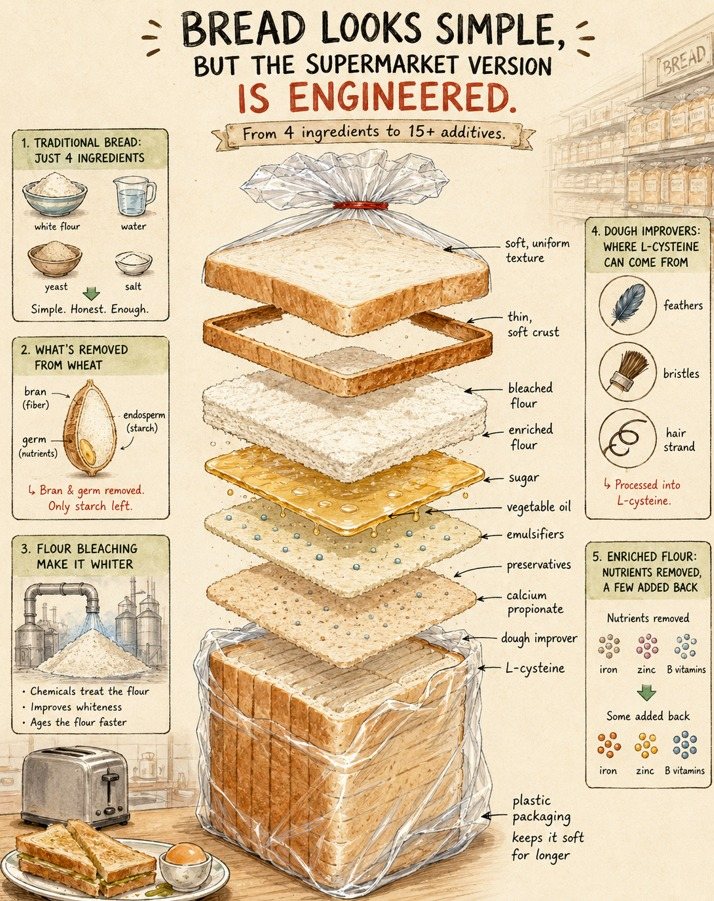
So why does the loaf in your kitchen have 25.
Pick up the packet. Read the back.
You'll see flour. You'll see water. Then the list gets longer. Emulsifiers. Preservatives. Sugar. Vegetable oil. Calcium propionate. Soy lecithin. And somewhere in that list, possibly under the words "dough conditioner" or "dough improver," you'll find an ingredient called L-cysteine.
L-cysteine is an amino acid. It softens dough and makes it easier to handle so factory machines can process it faster. It's in pizza dough, burger buns, supermarket loaves, and most commercial bread products.
The cheapest and most common source of L-cysteine is hair.
Human hair. Collected from the floors of barbershops and hair salons, mainly in China. The hair is dissolved in hydrochloric acid. The amino acid is extracted from the solution, purified into a white powder, and shipped to bakeries and food manufacturers around the world.
When human hair supply runs low, producers switch to duck feathers. Or hog bristles. A 2008 survey by the Vegetarian Resource Group found that duck feathers had become the source for roughly 80 percent of the world's L-cysteine supply. Human hair and hog bristles make up most of the rest.
Synthetic versions exist. They cost two to three times more. So most of the world's commercial bread still uses the cheap version. The one made from feathers, bristles, or hair dissolved in acid.
The FDA classifies it as safe. The label doesn't have to tell you where the L-cysteine came from. It just says "L-cysteine" or "dough improver." You'd never know.
And that's just one ingredient.
The flour itself is not what you think it is.
Freshly milled flour is not white. It's pale yellow, with a faint cream colour from the natural pigments in wheat. Left alone, it whitens slowly over several months as oxygen does the work. Bakers used to just wait.
But waiting costs money. So the industry bleaches it.
Commercial flour is treated with chemicals like benzoyl peroxide, chlorine dioxide, and chlorine gas. In the United States, two additional chemicals are still widely used: azodicarbonamide, known as ADA, and potassium bromate.
ADA is the same compound used to make yoga mats and shoe soles. In 2014, Subway came under fire when the public discovered that the same chemical in their bread was also used to make the foamed rubber in exercise equipment. The EU and Australia have banned its use in food. The U.S. still allows it.
Potassium bromate is classified by the World Health Organisation's International Agency for Research on Cancer as a possible human carcinogen. It has been banned in the EU, UK, Canada, China, Brazil, India, and South Korea. The U.S. still classifies it as "generally recognised as safe."
Two chemicals. Banned in most of the world. Still in American bread. And you'd never know because the label says "bleached flour" and nothing more.
But the real trick is what happens before the chemicals go in.
White flour is made by stripping away the two most nutritious parts of the wheat kernel. The bran, which is the outer layer, and the germ, which is the seed. What's left is the endosperm. Pure starch. Almost no fibre, vitamins, or minerals worth mentioning.
Then the industry adds synthetic versions of some of those nutrients back in. Folic acid. Niacin. Thiamine. Riboflavin. Iron. The result is called "enriched flour."
Think about that word. Enriched. They removed the nutrition. Then they added a fraction of it back in synthetic form. And they called the result "enriched," as if something had been gained rather than lost.
A slice of white bread made from enriched flour contains only a fraction of the fibre, vitamins, and minerals found in the whole grain it came from. The word "enriched" makes it sound like something was added. In reality, far more was taken away.
And for most of human history, this was a luxury.
White bread used to be expensive. Refining flour took time, skill, and equipment that only the wealthy could afford. In medieval Europe, the colour of your bread told the world your class. Rich people ate white. Poor people ate brown.
Today, the opposite is true. White bread is the cheapest option on the shelf. Whole grain is the premium. The status symbol flipped completely. What was once a sign of wealth is now the most processed, least nutritious, most chemically treated bread you can buy.
And it's the one most people reach for.
In Singapore, you know this bread.
It's the loaf in the plastic bag. The one you use for kaya toast in the morning and peanut butter sandwiches in the afternoon. The one your kids eat without thinking. The one you've bought a hundred times without ever turning the packet around to read the back.
Four ingredients is all bread ever needed. Flour, water, yeast, salt. For 14,000 years, that was enough.
Now it takes 25 ingredients, a bleaching process borrowed from the chemical industry, and a dough conditioner made from duck feathers dissolved in acid.
The packaging calls it "enriched." The packaging calls it "improved."
The bread just calls it Tuesday.