The Origin, 7 July 2026
Go to your bathroom. Stand in it. Look around.
That's about 25 square feet. In Hong Kong, that's somebody's home.
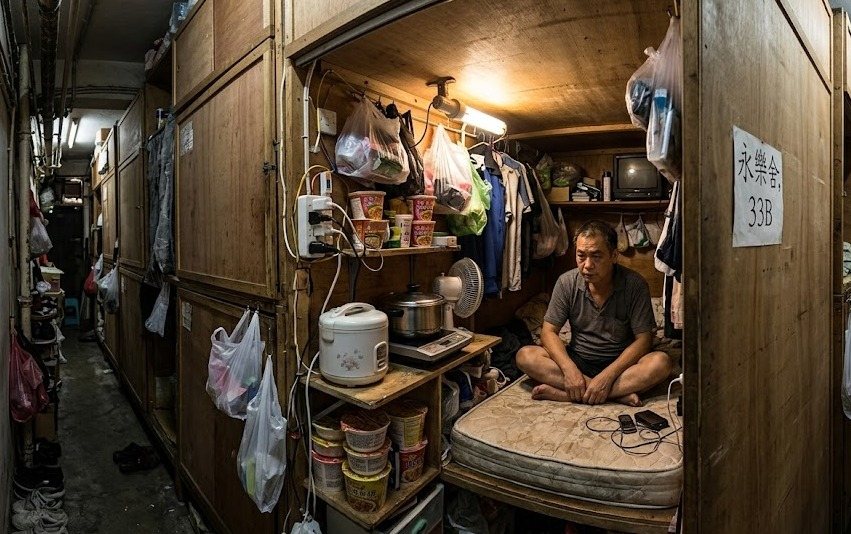
They're called coffin homes.
A coffin home is a sealed wooden box, roughly six feet long and two and a half feet wide, stacked inside an apartment with up to 20 others. Some are wire cages with padlocks. Some are wooden pods with a thin door that barely closes. Inside, there's a mattress, a few belongings, and just enough room to sit up. Not enough room to fully stretch your arms.
A single apartment of 400 square feet, about the size of a Singapore studio flat, can be carved into 20 of these spaces. Each one rented out separately. Each one someone's bedroom, living room, and storage. Combined.
There are more than 108,000 subdivided units in Hong Kong. Over 215,000 people live in them. Including 40,000 children.
The United Nations has called it "an insult to human dignity."
Let me tell you about Kei.
Kei is 60 years old. He works as a cleaner. He earns about HK$500 a day, roughly S$85. He pays HK$2,200 a month for a coffin home in Mong Kok. It measures 20 square feet. He shares the flat with 14 other tenants. His space has bedbugs.
He's been waiting for public housing. The average wait in Hong Kong is 5.3 years. For a single man like Kei, without children or elderly dependents, the wait could stretch to a decade.
Then there's Au. She's 75. A widow. She pays HK$2,500 a month for 25 square feet. She told a reporter she's always wanted a puppy. But there's no room. There's barely room for her.
At HK$100 per square foot, coffin homes charge some of the highest rents per square foot in the entire city. The people who can least afford housing are paying the most per unit of space.
Hong Kong didn't plan for this. That's the problem.
Hong Kong is one of the richest cities on earth. Its GDP per capita is among the top 20 globally. Its skyline is studded with some of the most expensive real estate ever built. And yet 215,000 of its people live in spaces smaller than a parking spot.
The reason is land. Only 25 percent of Hong Kong's total land area has been developed. Most of the rest is country parks and protected hillside. Of the developed land, just seven percent is zoned for residential housing.
Seven percent. For 7.5 million people.
The result is the most unaffordable housing market in the world. The average home price in Hong Kong is over HK$13,000 per square foot. For decades, the government relied on high land prices as a major source of revenue. Selling land to developers brought in billions. Building public housing didn't. The incentives pointed in the wrong direction.
Private developers built luxury towers. Public housing fell behind demand. And the gap filled with coffin homes, cage homes, and subdivided flats where families raise children in rooms the size of a dining table.
The government has promised to fix it. Beijing has set a target of 2049 to eliminate substandard subdivided housing. But new regulations announced in 2024 explicitly excluded coffin homes from their scope. The worst housing in the city will remain untouched by the new rules.
Now think about Singapore.
Singapore is a small island too.
Smaller than Hong Kong, in fact. About 735 square kilometres versus 1,110. Both cities are dense, expensive, and Asian. Both were British colonies with similar starting points.
But here's where the paths split.
In 1960, Singapore created the Housing and Development Board. At the time, only nine percent of the population lived in government housing. The rest crowded into slums, squatter camps, and shophouses where 80 people could share a single building.
A year later, the Bukit Ho Swee fire destroyed 2,800 homes and left 16,000 people without shelter. The government rehoused the families within months. That fire proved what the HDB could do when it moved fast. And it never slowed down.
Over the next six decades, the HDB built over a million flats. Today, 85 percent of Singaporeans live in HDB housing. About 90 percent own their homes. The homeownership rate is one of the highest on earth.
A two-room HDB flat is about 484 square feet. A three-room flat is about 645 square feet. A four-room flat is about 968 square feet.
Kei's coffin home is 20.
The monthly mortgage payment on a subsidised HDB flat in Singapore is often less than what Kei pays for his 20 square feet of bedbug-infested space in Mong Kok.
The difference between these two cities is not wealth. It's policy.
Hong Kong chose to let the market drive housing.
Singapore chose to let the government build it.
Hong Kong used land sales as revenue while Singapore used land as infrastructure. One city built luxury towers for investors. The other built towns for families, complete with schools, hawker centres, clinics, parks, and playgrounds.
Both decisions made sense to the people who made them. One produced a skyline that investors admire. The other produced a country where almost everyone has a home.
I live in Singapore.
I have a kitchen, a living room, and bedrooms for my family. I have windows. I have a door that locks. I have space to put my things and room to stretch my arms.
I take all of it for granted. Every day. Without thinking.
But somewhere in Mong Kok right now, a 75-year-old woman is sitting in 25 square feet, paying S$430 a month, dreaming about a puppy she has no room to keep.
And 40,000 children in Hong Kong are growing up in spaces that the United Nations has called an insult to their dignity.
Your HDB flat might feel small some days. The corridor might feel narrow. The neighbours might be loud. The lift might take too long.
But it's yours. And there's room to breathe.
That's not an accident. Someone decided, sixty-five years ago, that a small island could choose to house its people instead of pricing them out.
We live in the version of the story that worked.
Not everyone does.