
3am Stories, 3 March 2026
The Void Deck Belongs to Everyone
Part me. Part fiction. All love.
3am Stories...
The Void Deck Belongs to Everyone
She died on a Monday.
Mdm Lim Ah Eng. Block 82, Toa Payoh. Unit 0X-XXX.
79 years old. 154cm. Diabetic.
Hard of hearing in her left ear.
Could still shell a kilo of prawns faster than anyone in the market.
She died the way most Singaporean grandmothers die... quietly, in the bedroom, sometime between midnight and dawn, while her daughter was asleep in the next room and the aircon was set to 25 and the altar she prayed at every morning was still holding the two oranges she'd placed there on Sunday.
Her daughter, Bee Lian, found her at 6:15am. She knew before she touched her. The way you know. The stillness was different from sleep. Sleep has a rhythm. Death has a flatness, like a lake with no wind.
The ambulance came. The pronouncement was made. The calls went out. And by 3pm on Monday, the funeral director had arrived at Block 82 and the void deck began its transformation.
The white tent went up. The altar was arranged... chrysanthemums, the portrait from her 70th birthday, the one where she's wearing the jade bracelet her husband gave her in 1971, the year he proposed at the old Great World amusement park. Joss sticks in a brass urn. Red paper on the stairway landings, all the way up to the twelfth floor. The monks would come at 7pm for the first night of chanting.
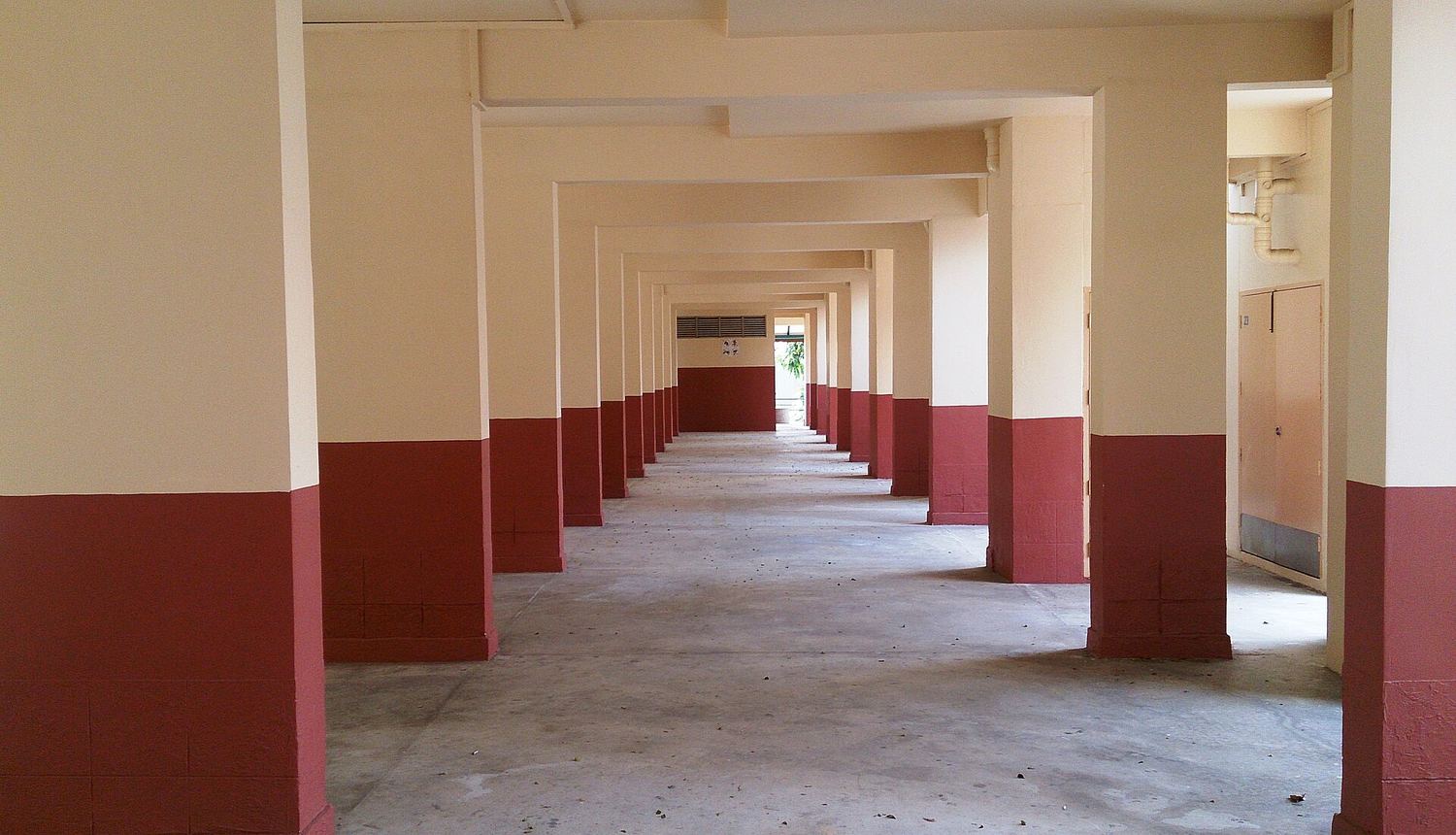
By 4pm, the void deck was no longer a void deck.
It was Mdm Lim's last living room.
Open on all sides.
No walls. No doors.
Because in Singapore, death does not happen behind closed doors. It happens on the ground floor, where everyone can see, where the whole building walks past it on the way to the letterbox, where children on bicycles slow down and stare and ask their parents, "What's the tent for?" and the parents say, "Someone's ah ma passed away," and the child nods and rides on, and something invisible is planted in them that will only bloom decades later when it is their turn to stand at the edge of a tent and not know what to say.
You need to know who Mdm Lim was.
Not because she was special. Because she wasn't. Because she was ordinary. Because she was every ah ma in every block in Singapore, and if you've ever had one, you already know her.
She lived in Block 82 for thirty-four years. Moved in with her husband in 1992 when the flat was new and the corridor smelled like fresh paint and the playground downstairs had a dragon-shaped slide that has since been replaced by something safer and uglier.
Her husband died in 2009. Heart attack.
She found him in the kitchen. He was making Milo. The mug was still on the counter, half-filled, when the ambulance came. She kept the mug. It's in the cupboard. She never used it again but she never threw it away because throwing it away would mean he wasn't coming back and she knew he wasn't coming back but the mug didn't need to know that.
After he died, she became the kind of woman every HDB block has one of.
The auntie on the stone bench.
The one who sits there every afternoon from 3pm to 5pm with a folded newspaper and a thermos of barley water, watching the world pass.
She knew every child in the playground by name.
She knew who was pregnant before the family announced it.
She knew which couples were fighting because the wife would come down alone and sit on the other bench and stare at nothing and Mdm Lim would walk over and sit beside her and not say anything because sometimes the most useful thing a seventy-nine-year-old woman can offer a thirty-two-year-old one is silence.
She held the lift.
Every time.
For everyone.
Even when it took her thirty seconds to walk from the bench to the door. She'd see you coming from the corridor and she'd press the "open" button and hold it and wait, her small hand flat against the door, and when you arrived she'd say, "Faster lah, my arm pain already," and she'd smile and the smile was the kind that has wrinkles and gold teeth and absolutely no ambiguity about whether it's real.
She fed people. That was her love language. You came to her flat, you left with a container.
Bak zhang in June.
Pineapple tarts in January.
Kueh lapis for no reason at all.
She once gave a container of tau suan to the Bangladeshi construction workers building the new block across the road because they were sitting on the kerb at lunchtime eating bread and she said to Bee Lian, "They look hungry. And lonely." Bee Lian said, "Ma, they don't know you." Mdm Lim said, "So? They look hungry."
She didn't speak Bengali. They didn't speak Hokkien. She handed them the container. They looked confused. She mimed eating. They laughed. She laughed. They ate. She walked away. The container came back two days later, washed, with a note in English that someone had clearly helped them write: "Thank you, Auntie."
She kept the note. It's in the drawer with the Milo mug and the jade bracelet and the photograph from Great World and all the other things that were too small to matter and too important to lose.
That was Mdm Lim Ah Eng.
Five feet nothing. Container always full. Hand always on the lift door.
The first person to come to the void deck was not family.
It was Makcik Rosnah. Third floor. Sixty-seven. She heard from the market.
Word travels in Toa Payoh the way it has always travelled in places where people live close... not through the news, but through the aunties. Someone told someone at the wet market who told someone at the kopitiam and by 10am Makcik Rosnah was in her kitchen.
She didn't call Bee Lian. She didn't text. She cooked.
Chicken curry.
Not Chinese-style.
Malay-style.
Rich, thick, coconut milk, the kind that takes two hours and fills the flat with a smell that reaches the corridor.
She packed it in the old pot, the one with the loose handles. She made white rice. She packed that too. Then she put on her tudung, took the lift down, walked past the tent that was still being set up, and found Bee Lian sitting on a plastic chair at the edge of the void deck.
Staring at nothing the way you stare when your mother has just died and the world is still operating normally. And you can hear traffic and birds and the announcement from the nearby school and none of it makes sense because the most important person in your life is lying in a casket twelve feet away and the birds don't care.
Makcik Rosnah put the pot down. She didn't hug Bee Lian. That's not how it's done, not between them, not in this generation, not in this corridor. What she did was this:
She took a tissue from her sleeve.
She tucked it into Bee Lian's hand.
Gently.
The way you tuck a blanket around a child. Then she put her hand on Bee Lian's shoulder... just rested it there, the weight of a palm, no more... and said:
"Your mother ah... she was the best kind of neighbour. She always give me kueh lapis. Every year. I never ask. She just give. That kind of person, Bee Lian, very hard to find."
Then she said the thing that every Singaporean auntie says when someone is grieving, the five words that are worth more than any speech or sermon or eulogy:
"You all eat first, ah."
Bee Lian looked at the pot. She couldn't speak. She nodded.
Makcik Rosnah patted her shoulder twice. Then she walked to the altar. She didn't light joss sticks. She's Muslim. She doesn't do that.
But she stood there, in front of the portrait of Mdm Lim... the one with the jade bracelet and the gold-tooth smile... and she bowed her head, very slightly, and said something under her breath.
A prayer.
Her own prayer.
In her own language.
For a Chinese woman she'd lived three floors above for nineteen years.
Nobody saw it. Nobody photographed it. It happened between a Malay woman and a portrait in a void deck on a Monday afternoon and it was, perhaps, the most religious act anyone performed that week... a woman praying for another woman in the language of her own God, trusting that God has ears in every language and that kindness is the one prayer that needs no translation.
Mr Rajan came at 5pm. Eighth floor. 71. Retired maths teacher. He wore the blue polo shirt, which Bee Lian noticed because he always wears the blue polo shirt on Mondays. He's been doing it since his wife died. She used to lay out his clothes. He kept her system.
He didn't know what to say. He never does at these things. He once stood at a funeral for fifteen minutes trying to compose the right sentence and eventually just said, "I'm sorry." Two words. But he said them slowly, the way a man says something when he means every letter.
He said it again today. "I'm sorry, Bee Lian. Your mother was a good woman."
Then he looked around the void deck. The tent was up but the chairs were still stacked against the pillar. Forty plastic chairs in a tower. The funeral director was on the phone. Bee Lian's brother was dealing with the monks. Nobody was setting up.
Mr Rajan walked over to the chairs. Started unfolding them.
One by one. Setting them in rows.
His back hurt. His knees cracked. He did it the way he used to arrange his classroom every morning at Zhonghua Primary for thirty-one years... desks in rows, chairs tucked in, whiteboard wiped, before any student arrived.
A good room is a room that's ready before people get there.
He set up all 40 chairs. Then he found an extension cord, plugged in the fairy lights. Straightened the cloth on the table. Moved a vase of flowers two inches to the left because it was blocking the portrait and he thought Mdm Lim deserved to be seen clearly.
Bee Lian watched him from across the void deck. This old Indian man. Moving things. Fixing things. Making the space right. She wanted to say thank you but she was afraid that if she opened her mouth right now what came out would not be words.
He caught her eye. He didn't need the thanks. He gave her the smallest nod... the kind men give each other at funerals, the one that means: I know. I've been here. It gets different.
Not better. Different.
The Pereiras came at 7pm.
10th floor.
Eurasian.
Catholic.
Married forty-six years.
She used to be a nurse at Tan Tock Seng. He used to work at the port. They hold hands when they walk to the market. They finish each other's sentences. They argue about the thermostat every single night and have not once, in forty-six years, resolved it.
Mrs Pereira went straight to Bee Lian. She took both her hands. Held them. The way a nurse holds hands... firm, warm, with the kind of pressure that says I know what loss looks like and I'm not afraid of it and I'm not going anywhere.
"Ah Eng was a lovely woman," she said. "Do you know what I'll remember? Every evening when I come back late, she hold the lift for me. Every time. My knees are bad, I walk slow, but she always wait. She see me coming from far, she press the button. I tell her, 'Ah Eng, don't wait, later your hand pain.' She say, 'My hand can pain. Your knees worse than my hand.'"
Mrs Pereira laughed. Then she cried. Then she laughed again, at herself for crying.
"Stupid, right? Crying over a lift."
It's not stupid.
It's not about the lift.
It's about a woman who saw you coming from far away and decided you were worth waiting for.
Every day.
Without being asked.
Without expecting thanks.
Just a small hand on a metal door and three extra seconds of patience and the quiet, radical belief that the person walking slowly down the corridor matters enough to hold the door.
That's not a lift. That's a life philosophy. And it died on a Monday at 79 and the only people who will remember it are the ones who lived in the same building and walked the same corridor and arrived at the lift just in time to see a small hand pressed flat against the door and a gold-tooth smile that said: come, I wait for you.
Joy came last. Around 9pm. She is the Filipino helper from 0X-XXX, next door. She'd finished washing up and putting the old man she cares for to bed. She stood at the edge of the tent in her house clothes... t-shirt and shorts and rubber slippers, the uniform of someone who didn't plan to attend a funeral tonight but couldn't not come.
She knew Mdm Lim. Not the way family knows. The way the bench knows.
Every afternoon, Joy sat on the stone bench outside Block 82 during the old man's nap. Mdm Lim sat on the same bench. They shared it. Sometimes they talked... Joy would show her pictures of her daughter's school concert in Davao, swiping through her phone slowly because Mdm Lim's eyes were not great. Mdm Lim would say, "Wah, pretty girl. Look like you."
And Joy would smile because nobody in Singapore tells her she's pretty and this old Chinese woman said it every week like it was a fact.
Sometimes they didn't talk. They just sat. The way you sit with someone when the silence is its own conversation and neither person needs to fill it because being beside each other is enough.
Mdm Lim never asked Joy how much she earned. Never asked about her papers. Never asked why she was here instead of there. She just moved her newspaper fan to make room on the bench and said two words:
"Sit, sit."
The most Singaporean invitation ever offered. No questions. No qualifications. Just: there is space. You are welcome to it.
Joy stood at the edge of the tent holding two mandarin oranges. She'd seen them on altars before. She didn't fully understand the meaning but she understood that you bring something. She placed them at the corner of the table.
Bee Lian saw her. Walked over.
"Joy. Come sit. Ma would want you here."
Joy sat. In a plastic chair that Mr Rajan had unfolded.
At a Chinese Taoist wake.
A Catholic Filipina from Mindanao, holding a cup of chrysanthemum tea, listening to chanting in Hokkien, mourning a woman who shared a bench with her every afternoon and never once made her feel like a foreigner in someone else's country.
The chanting rose. The joss sticks burned. Outside the tent, the evening moved on... motorcycles, the distant MRT, children being called home for dinner. Inside the tent, five women and one retired teacher from four different countries and three different religions sat in plastic chairs and remembered a woman who held the lift.
Nobody photographed it. Nobody posted it. It was not a campaign or a movement or a hashtag.
It was just Monday in an HDB block.
It was just Singapore.
The world is on fire right now.
You've seen the news. Bombs in the Middle East. Missiles crossing borders. Countries choosing sides. The internet sorting people into teams by religion, by race, by blood.
And the sparks always travel. They land on small countries. They land on group chats and dinner tables and comment sections. They land on the space between neighbours and they whisper: pick a side. They whisper: that person is not like you. They whisper: "us" and "them."
Let me tell you something about this country.
We had no natural resources. No oil. No land. No strategic depth. No hinterland. When we became independent in 1965, nobody gave us a chance. A tiny island, three million people, four languages, five religions, a hundred dialects, freshly scarred by racial riots that left twenty-three dead in 1964 and more in 1969.
The world looked at us and said: too small, too divided, too different from each other.
You'll tear yourselves apart within a decade.
We didn't.
We built one of the safest countries on earth. One of the most prosperous. One of the most trusted. A first-world nation from a fishing village in sixty years. A financial centre. A port that the world depends on. An education system that countries three times our size study and try to replicate. We did this with nothing except one thing that no amount of money can buy and no government can manufacture:
We did it together.
Chinese, Malay, Indian, Eurasian, and every person who came to this island and decided to call it home.
Together.
Not in spite of our differences.
Through them.
Because the Malay makcik brought curry to the Chinese funeral. Because the Indian teacher unfolded the chairs. Because the Eurasian nurse held the hand. Because the Filipino helper sat down and belonged. Because a million tiny acts of choosing each other, every day, in every block, in every void deck, compounded into something so strong that the world still can't quite explain how we did it.
That is Singapore's real miracle. Not the skyline. Not the reserves. Not Changi Airport or Marina Bay or the GDP per capita.
The miracle is that Makcik Rosnah knows Bee Lian's name. That Mr Rajan moves a vase two inches so a portrait can be seen. That Joy is told "come, sit" and she sits and she belongs.
The miracle is the void deck on a Monday evening... six people, four countries, three religions, one tent, and nobody thinking about race because they're too busy thinking about the woman who held the lift.
That is the engine.
That is the thing that built everything else.
Every skyscraper in the CBD was built on the foundation of a Chinese grandmother giving tau suan to Bangladeshi workers because they looked hungry.
Every trade deal was underwritten by the trust of a country where a Malay wedding and a Chinese funeral can share a void deck and nobody riots. Every foreign investor who chose Singapore over somewhere bigger, somewhere cheaper, somewhere with more land, chose us because they looked at this island and saw the one thing that most countries cannot produce....
People who are different from each other and who figured out how to build together anyway.
That is rare.
Rarer than you think.
Go look at the news.
Countries with ten times our land and a hundred times our resources are tearing themselves apart right now because they could not do what we did.
They could not put a Makcik Rosnah next to a Bee Lian next to a Mr Rajan next to a Joy and make it work. We did. Not because we're better people. Because we chose it. Every day. For 60 years. One curry at a time. One chair at a time. One held lift at a time.
And that is exactly why we cannot take it for granted.
Because the thing about choosing is that you can stop. You can stop any time. You can let the forwarded message do the choosing for you.
You can let the algorithm decide that the person three doors away is no longer your neighbour but your category.
You can let a war eight thousand kilometres away redraw the lines that 60 years of living together erased, and you can wake up one morning in a country that still has the skyline and the reserves and the airport but has lost the thing that made all of it possible.
The void deck.
The pot of curry.
The chairs.
The hand on the lift door.
Don't let that happen.
If someone in your group chat starts drawing lines between "us" and "them"... be the one who says: not here. Not us. Not this country. We didn't survive sixty years as an independent nation by sorting ourselves into sides. We survived by refusing to.
If you see your neighbour tomorrow morning... the one you've been nodding at for years but never spoken to... stop. Say good morning. Ask their name. Because Mdm Lim knew every name on her floor. And look what that built.
And if someone in your building dies next week, and the tent goes up, and the chanting starts, and the joss sticks burn or the prayers are recited or whatever it is that the family does in their tradition that you don't fully understand...
Go down.
Bring food. Unfold chairs. Hold a hand. Bring two oranges. You don't need to know the customs. You don't need to speak the language. Just show up. The way Mdm Lim showed up every afternoon on that bench. Not because she had something to say. Because she knew that sometimes the most important thing you can do for another person is make room and say:
"Sit, sit."
The void deck has no walls.
That was never a design flaw.
That was the whole point of Singapore.
— 3am Stories by Alvin Huang
Send this to someone who lives in your block. Not because the world is on fire. Because the void deck belongs to everyone, and it only stays that way if everyone keeps walking 0