
3am Stories, 16 April 2026
The Kompang Woke Me Up
Part me. Part fiction. All love.
3am Stories
The Kompang Woke Me Up
Saturday morning.
Maybe seven, maybe earlier.
I was ten years old and the kompang woke me up.
If you grew up in an HDB block with Malay neighbours, you know that sound.
Not just drums.
A rhythm that fills the void deck and rises through twelve floors of concrete until it's inside your bedroom and your chest at the same time. Kompang doesn't knock. It announces. And what it announced, on maybe a dozen Saturdays across my childhood, was that somebody downstairs was getting married.
But the wedding didn't start on Saturday morning. It started Friday night.
You'd hear it from the corridor after dinner. Metal poles clanging. The tentage workers shouting to each other in Malay.
If you looked over the parapet, you'd see the void deck slowly transforming.
White canopy going up. Round tables appearing one by one. Plastic chairs stacked in towers, waiting to be spread out.
The fairy lights came last, looped through the pillars and taped along the edges of the tentage, and when they switched them on for the first time, the void deck looked like a completely different place. Like someone had built a ballroom under your block overnight.
And the smell.
If the family was doing their own cooking, the rendang started the night before.
Low and slow, the coconut milk and spices mixing into something so thick you could almost see it drifting up through the stairwell.
I'd lie in bed on Friday night with the window open, listening to the setup and breathing in rendang, and that combination... metal poles, laughter, and slow-cooked spice... that was the smell of someone else's happiness reaching your floor.
Saturday morning, my mother was already awake. She was always already awake on void deck wedding mornings. Wrapping something in foil. Kuih lapis, usually. Sometimes pineapple tarts if she'd been baking that week. "Go shower," she'd say. "We're going down."
We were Chinese.
The wedding was Malay.
Nobody sent us an invitation card.
We went anyway. Everyone went.
That's the part I keep coming back to. There was no guest list.
In Malay wedding culture, hospitality means you don't turn people away.
The family on the second floor right above the void deck would be invited first, because it's polite when the celebration is literally under your home. But beyond that, the whole block was welcome. The Indian uncle from the end of the corridor. The Chinese aunty who never talked to anyone. The kid from 12-04 who didn't even know the bride's name.
That kid was me.
The void deck on a wedding morning was already a different world by the time we came down.
The bunga manggar... those tinsel palm blossoms on bamboo poles... were standing at the entrance, catching the light. If you were arriving by bus and couldn't find the block, you'd spot the tinsel from the main road. Kids were already chasing each other between the tables. Makciks in baju kurung were behind the food station, stirring massive pots and arguing about something in a way that was clearly not an argument but just the sound of women who'd been cooking together since 4am.
And then the kompang would start.
The groom arriving with his entourage.
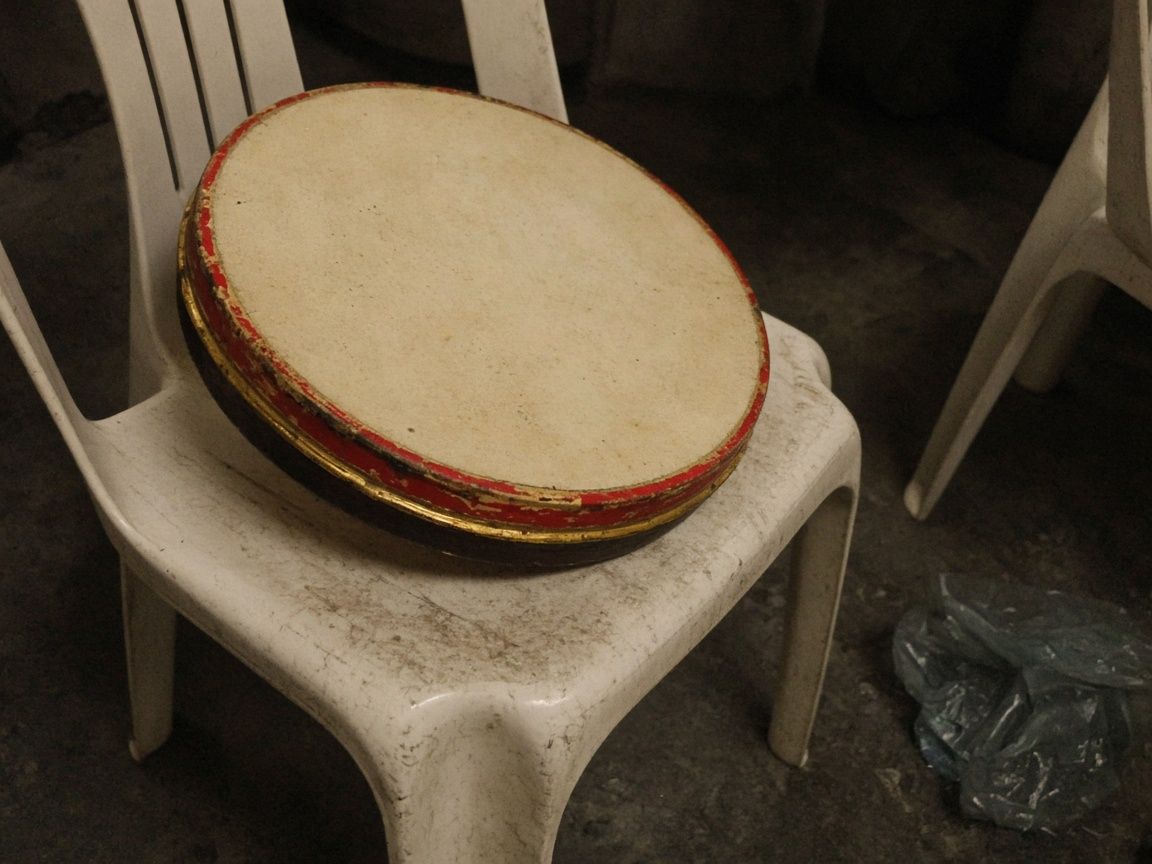
Kompang players leading the way, their drums locked into a rhythm you felt in your stomach before your ears, voices singing blessings.
Behind them, guys carrying the bunga manggar. And somewhere in the procession, someone would perform silat pengantin... this slow, graceful martial arts display that looked nothing like fighting. More like a prayer made with the body, each movement deliberate and respectful, performed in honour of the couple.
I'd watch all of this from a plastic chair, plastic plate on my lap, rendang and nasi minyak piled higher than my mother would normally allow because she wasn't paying attention.
She was talking to somebody's mother.
My father was at the next table doing the same thing.
For one afternoon, the block's invisible social rules dissolved. People who never spoke in the lift were sharing a meal.
Then the couple would sit together on the pelamin.
That's the raised dais, decorated with fabric and flowers until it looked like something out of a different century.
The bride and groom dressed like royalty, because in Malay tradition, on your wedding day, you are the king and queen.
Family would come up to offer blessings, sprinkle rice and rosewater.
The couple barely smiles.
They're not supposed to. And even as a Chinese kid who understood almost none of the ceremony, I remember feeling like I was watching something sacred. Something that trusted me enough to happen right in front of me, in the open, with no walls.
The weddings lasted all afternoon and sometimes into the evening.
People came and went.
That was normal.
You'd eat, go back upstairs, come down again two hours later, and the celebration would still be going.
The music shifted as the day went on.
Kompang in the morning, live band or karaoke by afternoon. Always an uncle who sang too well and always an aunty who sang with so much confidence that nobody had the heart to tell her otherwise. The kids would be running wild by then, weaving between tables, shoes off, playing catching on the concrete.
Before you left for good, the bride's family would give you a bunga telur.
A decorated hard-boiled egg, sometimes wrapped in netting, sometimes on a small stand.
A gift. A thank you for being there. I used to collect them.
Had three or four in the fridge at any given time and my mother would say, "Eat the egg lah, don't just keep the decoration."
I didn't understand everything I witnessed at those weddings.
I was ten, eleven, twelve. I just knew the food was incredible, the drums made my chest vibrate, and the bride always looked like she belonged in a painting.
But I understood one thing even then: nobody checked if I belonged there.
Nobody asked what floor I was from or whether my family knew the family.
We sat, we ate, we watched, and when it was over my mother would find the bride's mother and say congratulations and hand over the foil-wrapped kuih and that was it.
A Chinese family at a Malay wedding at an HDB void deck in Singapore. The most ordinary thing in the world.
I'm 44 now. The last wedding I went to was at a hotel ballroom in town. $188 per head.
Printed table cards. A QR code for the e-angbao. Air conditioned, seated, efficient. Two and a half hours, including the march-in, the speeches, and the slideshow of the couple's trip to Santorini.
Lovely. Really. The food was good, the room was beautiful.
But nobody walked in from the block next door.
Nobody brought kuih wrapped in foil because they heard the drums that morning.
Nobody's kid sat at a stranger's table eating rendang off a plastic plate while watching a martial arts prayer he didn't understand but would carry for thirty years.
And you couldn't stay for five hours, go home, come back, and find the party still going.
The void deck wedding is disappearing.
Newer HDB blocks have smaller void decks now, harder to fit the tentage. Younger couples prefer air conditioned venues with packages that include the catering, the decor, the photographer, everything under one roof.
And I understand that.
Weddings are expensive enough without worrying about rain and heat and whether the sound system will bother the neighbours.
But something goes missing when a wedding moves behind closed doors.
The void deck wedding belonged to the Malay community.
But the experience of it belonged to the whole block.
The void deck was everyone's space, and a wedding was the one event that reminded you of that. That your neighbour's joy could reach your kitchen. That the right celebration, in the right place, could turn five hundred strangers into guests.
I think about this a lot now.
The government spent decades running campaigns about racial harmony.
Posters, slogans, Racial Harmony Day at school where we'd all dress up in each other's clothes for one afternoon.
But the thing that actually made it work, for my generation at least, was a concrete floor with no walls and somebody's mother cooking rendang at 4am.
Nobody planned it.
The architecture just didn't give us a choice.
And because we had no choice, we had each other.
My daughter is 10. My son is 6.
They've never been to a void deck wedding.
They've never heard kompang drums rise through twelve floors of concrete on a Saturday morning, or sat at a table where they didn't know a single person and been fed anyway.
My daughter is the same age I was when the kompang first woke me up.
And I can't figure out where to take her to hear it.
If you ever walked past a void deck on a Saturday and the kompang pulled you in...
If you ever sat at a table where you didn't know the bride or the groom but the aunty still put food on your plate...
You already know what I'm talking about.
Some things shouldn't need a guest list.
- 3am stories. Pass it on