The Origin, 5 September 2026
The man tasked with building Singapore's army had one military qualification: he'd served as a corporal in a volunteer force that surrendered to...
The man tasked with building Singapore's army had one military qualification: he'd served as a corporal in a volunteer force that surrendered to the Japanese in 1942.
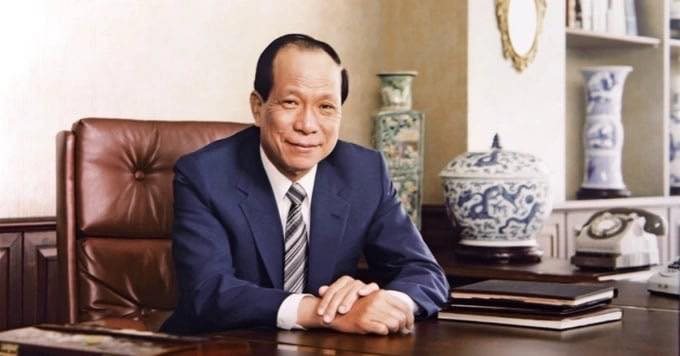
His name was Goh Keng Swee.
In August 1965, days after Singapore separated from Malaysia and became an independent country, he was appointed Minister for Interior and Defence.
He inherited two under-strength infantry battalions, about 50 officers, roughly 1,000 men, two small ships, and no air force. Indonesia alone had a population more than fifty times larger.
Lee Kuan Yew was deeply anxious about whether Singapore could survive as a sovereign state. Goh was among the most determined to prove it could.
His first move was to ask for help.
The answers were not encouraging.
Singapore approached India and Egypt, natural allies of the nonaligned world.
Neither provided the military assistance requested. Britain still maintained a large military presence in Singapore, but Goh was convinced that planning on permanent British protection would be folly.
Within days of independence, he contacted Mordecai Kidron, a former Israeli ambassador to Thailand. Kidron flew in from Bangkok.
Goh told him what he'd told nobody else publicly: only Israel, a small country surrounded by larger neighbours with no room to retreat, could understand Singapore's predicament.
Israel said yes. In October 1965, Major General Rehavam Ze'evi, known by his nickname "Gandhi," secretly visited Singapore to assess the situation.
He toured the island incognito and drew up a masterplan for a lean, integrated military. His philosophy, as Colonel Yaakov Elazari later recalled: not too many generals and too few soldiers.
By the end of 1965, Elazari and the first Israeli advisory team had arrived to begin implementation.
There was one problem.
Nobody could know they were Israeli.
Singapore sat between Malaysia and Indonesia, both Muslim-majority nations. Israeli military advisors operating openly could trigger a diplomatic crisis before Singapore had built an indigenous officer corps or a credible citizen army.
So the government gave them a cover name: the Mexicans.
Years later, Prime Minister Lee Hsien Loong explained the thinking at the Hebrew University in Jerusalem: "We called them 'Mexicans' for operational security, and also because we hoped that their swarthy looks might make the cover plausible."
The Mexicans arrived, trained, built, and wrote military doctrine while officially not existing.
What they built in under two years was remarkable.
SAFTI, the Singapore Armed Forces Training Institute, was established in February 1966. By June, 140 officer cadets had been selected from more than 2,000 applicants.
The Israelis insisted from the start that every position they filled was to be understudied by a Singaporean counterpart. Platoon commanders, company commanders, all the way up to director general staff.
They called it training the trainers. The goal was to make themselves unnecessary as fast as possible.
Lee Kuan Yew later noted the contrast.
The Americans had sent between 3,000 and 6,000 military advisors to help South Vietnam build its army.
Israel sent 18 officers.
The 18 built an army.
The cadets wrote their own instructional material.
They inherited something called the Brown Book: a military doctrine the Israelis had written specifically for Singapore's geography and threat environment. A playbook for defending an island with no fallback position.
Then came the day the Mexicans were unmasked.
On June 5, 1967, Israel launched what became the Six-Day War.
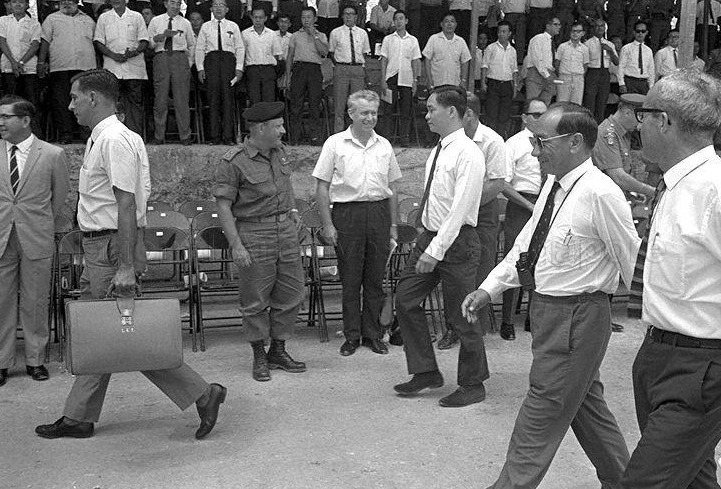
Five weeks later, on July 16, Goh Keng Swee did something no one expected. At the commissioning parade of Singapore's first 117 SAFTI officers, he told the Israeli advisors to attend in IDF uniform.
For the first time since arriving in Singapore, the Mexicans stood in public as Israelis. In uniform. In front of the officer corps they had just trained.
Goh addressed the audience: "You have heard of the Six-Day War, which commenced on June 5th. Seated here with me today are part of the Israeli mission which has been advising us on how to build an army."
The Mexicans were Israelis.
Their country had just won a war in six days.
And the army they'd been secretly building in Singapore was now standing on the parade ground in front of them.
One month later, National Service became real.
The NS Amendment Bill had already been passed on March 14, 1967, making military service compulsory for all 18-year-old male citizens and permanent residents. Some 9,000 males born between January and June 1949 received pink reminder cards by post. Registration took place at four stations: Kallang, Katong, Serangoon, and Bukit Panjang.
The anxiety was real.
On March 27, about 300 people demonstrated at New Bridge Road and Rochor Canal Road. Chinese families had a deep cultural aversion to military service. Malay families worried about being asked to confront Malaysia.
But the protests were smaller than the ones that had derailed a British conscription attempt in the 1950s, and registration compliance exceeded 96 percent.
The first batch of full-time national servicemen reported on August 17, 1967.
The top 10 percent of the 9,000, about 900 men, were selected for two years of full-time military training, 450 each in two new infantry battalions. The rest served in the People's Defence Force, the Vigilante Corps, or the Special Constabulary.
The model drew on two countries that had solved the same problem.
Lee Kuan Yew wrote that Singapore wanted to build "a citizen army like Switzerland's or Israel's."
Both were small states that generated military strength far beyond the size of their professional forces by training citizens and maintaining large reserves. Israel's advisors had directly designed much of the early system.
Switzerland provided the broader reference model for peacetime structure: a small professional core backed by a massive trained reserve that could mobilise within hours.
Every male serves two years of full-time service.
After that, reservist obligations continue until 40, or 50 for officers and specialists. The professional standing force is lean. The trained reserve is enormous. The principle is that Singapore can never be caught without an army, because the citizens are the reserve.
Goh Keng Swee died on May 14, 2010, at the age of 91.
He had served as Finance Minister, Defence Minister, Education Minister, and Deputy Prime Minister.
He co-founded the Economic Development Board, restructured the education system, and built the national savings drive that turned POSB into a household name.
But the thing that started with his appointment in August 1965, the thing he was least qualified for on paper, may have been the most consequential.
A corporal who surrendered in 1942 built an army that hasn't stopped running since 1967.
The Mexicans went home.
The system they helped design stayed.
More than a million Singaporean men have now served National Service. And every year, another generation reports for duty, many of them boarding the ferry to Pulau Tekong, and discovers what Goh understood from the beginning.
A country this small could never rely on a professional standing army alone.
It needed its citizens too.