The Origin, 29 June 2026
My sister moved out last year.
My sister moved out last year. She'd just got married, which meant her old room was finally free, which meant Trinity could have her own bedroom for the first time.
We bought her a new mattress for the occasion. It arrived in a vacuum-sealed bag, clean and white and full of promise. She tore the plastic off, flopped onto it, and declared it the greatest bed in the history of beds.
Then I made the mistake of looking up what happens to a mattress after a few years of use.
If you're reading this in bed right now, I'm sorry for what comes next.
You spend roughly a third of your life on a mattress.
That's about 26 years for the average person. Twenty-six years of lying in the same spot, breathing the same air, pressing your face into the same surface. And during every single one of those nights, your body does something it never tells you about.
It sheds.
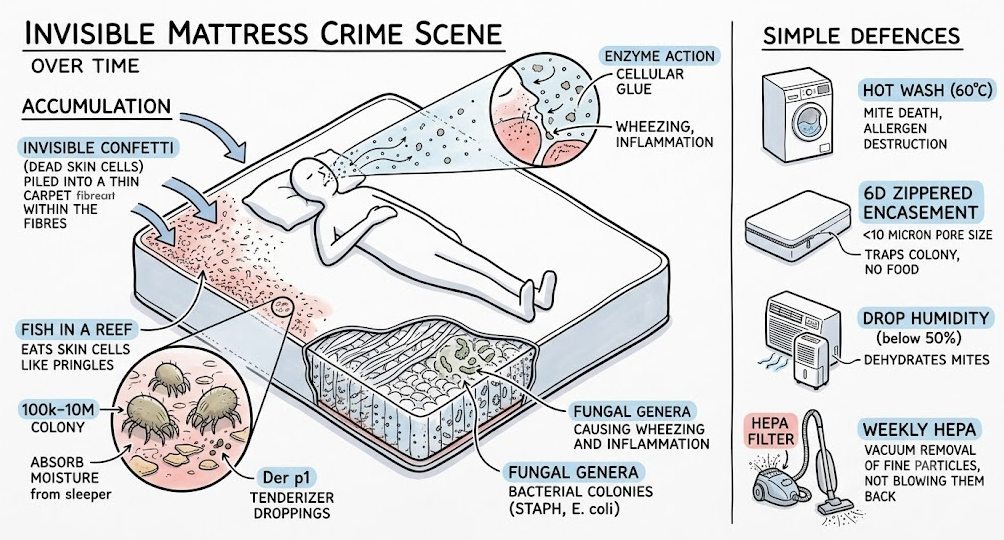
About 500 million skin cells a day. They drift off you like invisible confetti while you sleep, settling into the fibres and folds of your mattress. You don't notice because each flake is too small to see. But they pile up. And by morning, you've left behind a thin, invisible carpet of yourself.
This would be fine if the skin just sat there. But it doesn't.
It becomes food.
Dust mites, which are about a third of a millimetre long and completely invisible to the naked eye, live in your mattress the way fish live in a reef.
An Ohio State University study estimated that a used mattress hosts between 100,000 and 10 million of them. A single gram of mattress dust can contain over 100,000.
Glen Needham, a retired entomologist from Ohio State who spent decades studying these creatures, compared your dead skin cells to Pringles. Thin, protein-rich, easy to eat. Mites don't drink water. They absorb moisture directly from the humid air that your sleeping body generates. They don't need sunlight. They don't need to go anywhere.
"Every mattress is a crime scene," Needham once said, "in terms of how it gets inoculated with mites."
To a dust mite, you are everything.
The restaurant and the water supply and the central heating, all wrapped into one sleeping body.
You're the entire infrastructure of their civilisation, and you don't even know they're there.
But the really unsettling part isn't the mites themselves. It's what they leave behind...
Each dust mite produces about 20 droppings a day. These droppings contain a digestive enzyme called Der p1, which researchers have found is chemically similar to papain.
Papain is a meat tenderiser. It's the stuff you sprinkle on a tough steak to break down the fibres.
So the enzyme that dust mites excrete onto your mattress, your sheets, and your pillow, twenty times a day per mite, across millions of mites, is the biological equivalent of the chemical used to soften raw meat. When these droppings dry out and become airborne, you breathe them in. And the enzyme goes to work on the lining of your airways, breaking down the "glue" between your cells, which is why dust mite allergies cause wheezing, inflammation, and difficulty breathing.
You're not just sleeping with mites. You're being slowly tenderised by them.
And the bacteria are worse.
A study by Amerisleep found that a seven-year-old mattress contains over 16 million colony-forming units of bacteria per square inch. Staphylococcus aureus. E. coli. Four different bacterial types, thriving in the warm, damp environment your body creates every night.
Your pillowcase is even more horrifying.
After just one week without washing, a pillowcase carries about three million colony-forming units per square inch.
That's 17,442 times more bacteria than a toilet seat.
Your pillow. The thing you press your face into for eight hours. Seventeen thousand times dirtier than the thing you sit on in a bathroom. After seven days.
Researchers have also identified more than 20 genera of fungi quietly growing in mattress dust. Your bed is, in a very real sense, a biology experiment that you voluntarily climb into every evening and lie in for eight hours. With your mouth open.
None of this is new.
The oldest known sleeping surface was discovered in Sibudu Cave in South Africa. It's 77,000 years old. It was a mat of reeds, rushes, and leaves, large enough for an entire family. And here's the part that says everything about us as a species. Even 77,000 years ago, before agriculture, before the wheel, our ancestors were already fighting the bugs. They layered their sleeping mat with leaves from plants that naturally repel insects.
The very first mattress in human history came with built-in pest control.
We've been losing this fight for 77,000 years. We just got better at not thinking about it.
The word "mattress" comes from the Arabic *al-matrah,* meaning "a thing thrown down." Which is a charmingly honest name for something we now spend thousands of dollars on and argue about in showrooms on weekends.
For most of human history, a mattress was a sack of straw or hay.
Sometimes horsehair if you were wealthy.
Feathers if you were rich.
Medieval bed frames were strung with ropes that sagged over time, which, according to popular legend, is where the phrase "sleep tight" comes from. The idea is that you had to tighten the ropes before bed.
That's also probably wrong. Linguists point out that the phrase first appeared in 1866, well after rope beds had fallen out of use. The Oxford English Dictionary says "tight" simply meant "soundly" in older English, the same way "sit tight" means "stay put." Just a quiet wish for a good night's rest. No ropes required.
You may also have heard the famous claim that a mattress doubles in weight every ten years from accumulated dead skin, sweat, and mite droppings. This has been repeated on morning TV, in mattress showrooms, and across the internet for two decades.
Also wrong. The researcher originally quoted for the claim said he was misquoted. The NYU microbiologist who repeated it later admitted he'd been mistaken. When a TV station actually weighed a ten-year-old mattress, it had gained about five percent. Not double. Five.
Two famous "facts" about mattresses. Both myths. And somehow, the actual facts are worse than either of them.
===============================
So after all that, can you actually do anything about it?
You can.
And the answer, after everything you've just read, is almost embarrassingly simple.
Wash your sheets every week in water that's at least 60 degrees Celsius.
At 40 degrees, which is what most people use, 94 percent of dust mites survive the wash. They just tumble around in the warm water like a spa day and climb right back into your bed.
At 60 degrees, they die.
Their allergen proteins break apart.
The droppings dissolve.
It's not glamorous.
It's just hot water. But it works.
Get a zippered mattress encasement. Not a fitted sheet, not a mattress topper, but a proper six-sided cover with a pore size under 10 microns that seals the whole mattress in. Clinical trials found this is the single most effective intervention for dust mite allergen reduction.
You're essentially trapping the colony inside and cutting off its food supply. The mites are still in there. But they can't get to you, and you can't breathe them in.
Keep your bedroom humidity below 50 percent.
Dust mites can't drink.
They absorb moisture from the air.
Drop the humidity and they dehydrate. In Singapore, where the air itself sweats, this means running the aircon or a dehumidifier. It's the unsexy cousin of climate control, but mites can't survive in dry air no matter how many skin cells you leave them.
HEPA vacuum your mattress once a week. A study found that daily vacuuming with a HEPA filter reduced total dust mite allergens by roughly 85 percent over eight weeks. The HEPA part matters. A normal vacuum just blows the fine particles back into the air you breathe.
That's it. Hot water, a cover, dry air, and a good vacuum.
77,000 years of losing the war against bed creatures, and the solution was available at any hardware store. Billions of dollars in mattress technology, memory foam from NASA, Bluetooth-enabled sleep tracking, and the most effective defence against the things living in your bed is a zippered bag and a washing machine set to 60.
Trinity doesn't know any of this.
She stretched out on her new mattress with the confidence of someone who has never googled "dust mite enzyme."
The vacuum-sealed bag is long gone. The sheets are on. The room is hers.
How about you? What would you do?