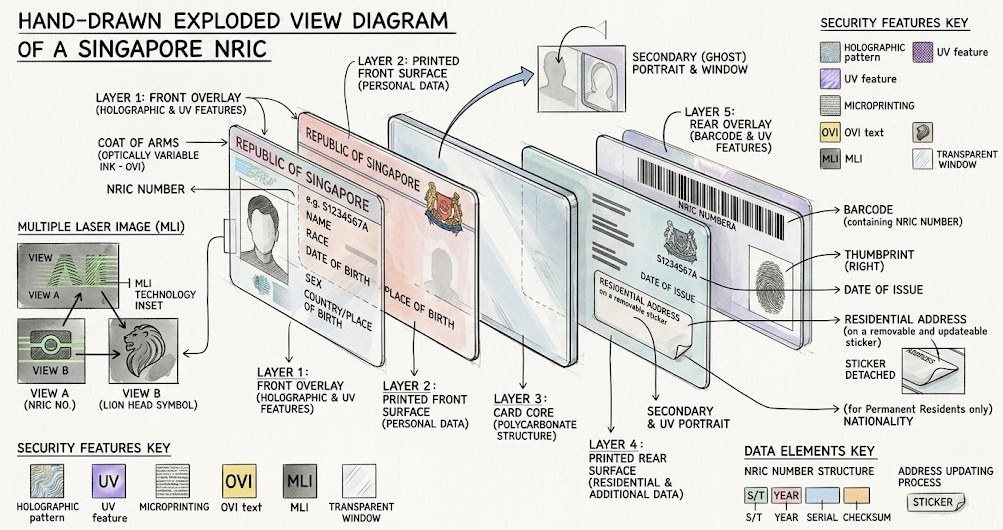
The Origin, 21 August 2026
The first NRIC number ever issued in Singapore was S0000001I.
That's officially confirmed.
ICA says it was assigned to Yusof bin Ishak, Singapore's first President, when the newly independent country introduced its own national registration system in 1966, replacing the colonial identity cards that had been in use since 1948.
A widely reported list assigns the next six to the other founding figures: Wee Chong Jin, Lee Kuan Yew, Kwa Geok Choo, Toh Chin Chye, Goh Keng Swee, S Rajaratnam. Lee Kuan Yew's S0000003E appears in legal documents.
The rest of the sequence is consistent across sources but hasn't been confirmed by ICA the way the first number has.
What is confirmed: the system began with the President and moved outward. Your IC belongs to the same system. And most of what it contains, you've probably never thought about.
Start with the first letter.
Before 2000, most Singaporeans assumed S stood for "Singapore." Today, S and T function as century-range prefixes: S, the 19th letter of the alphabet, covers citizens and permanent residents born in the 1900s. T, the 20th letter, covers those born from 2000 onward.
Whether S originally stood for "Singapore" or was always a century marker is one of those questions Singapore has never officially answered.
What's clear is that when T arrived in 2000, the alphabetical logic became the working explanation.
Foreigners follow a different track. F for long-term pass holders registered before 2000. G from 2000 through 2021. M, introduced in January 2022, for new foreign pass holders. The prefix tells you whether someone is in the citizen-or-PR series or the foreigner series, and which year range applies.
Now look at the seven digits in the middle.
If you're a citizen or PR born after 1968, the first two digits correspond to your birth year. S71 means born in 1971. T05 means 2005.
That number sits on a card you hand to clinic receptionists and bank counters. The first two digits can reveal your year of birth to anyone who knows the convention.
If you were born before 1968, the digits don't encode birth year. They commonly start with 0 or 1 and were assigned in order of registration.
And then there's the last letter. This is where it gets strange.
That final character is not random. It's not assigned by a clerk. It's calculated by a mathematical formula.
Take your seven digits. Multiply each one, in order, by the weights 2, 7, 6, 5, 4, 3, and 2. Add the products together. If your prefix is T or G, add 4 to the total. If it's M, add 3. Divide the result by 11. Take the remainder. Convert it to a letter using a prefix-specific lookup table.
That letter is your check digit. It's called a modulus 11 checksum. The older ISBN-10 system used the same mathematical principle to validate book numbers. Your identity card uses the same type of maths as a 1990s library catalogue.
The check digit catches many common typing and transcription errors. If a digit is entered wrong, the calculated letter won't match, and the system flags it. It doesn't verify who owns the number. It verifies that the number itself is structurally valid.
You can test this yourself.
Take S0000001. The only non-zero digit is the last one: 1. Multiply it by its weight, which is 2. The sum is 2. Divide by 11. The remainder is 2. Look up 2 in the S-prefix table.
The answer is I.
S0000001I. The number ICA officially assigned to Yusof bin Ishak. The checksum matches.
Take S0000003. Last digit 3, multiplied by its weight of 2, gives 6. Divide by 11. Remainder 6. Look up 6.
The answer is E.
S0000003E. The number independently documented as Lee Kuan Yew's. The checksum matches again.
Same formula. Same weights. Same division by 11. Applied to every NRIC in the country.
The formula wasn't always public.
In the early 2000s, ICA offered the official algorithm to approved Singapore-based organisations for S$200, with sample code costing S$400. Access required a demonstrated "legitimate need" and ICA's sole approval.
But the S-series formula was already circulating in Singapore internet newsgroups by the mid-1990s.
In 2003, a researcher named Ngiam Shih Tung publicly reconstructed the broader algorithm covering all prefix types, working it out by cross-referencing publicly listed names with their IC numbers. NUS taught the method in a coding theory course. Today, the weights, the modulus, and the lookup tables are freely available online.
A formula that once required an application and a fee now fits on a napkin.
Nine characters. That's all your NRIC is.
One letter that places you in a century range and identifies whether you're in the citizen-or-PR series or the foreigner series.
7 digits that may encode the year of your birth.
And one letter that is the output of a compact mathematical function applied to everything before it.
Those 9 characters sit on your birth certificate, your school records, your CPF statement, your HDB lease, your hospital file, and eventually your death certificate.
They follow you from registration to grave.
As of 2026, the government's position has shifted. Your NRIC number, it now says, should be treated as an identifier, not a secret.
It shouldn't function as a password or proof of identity. The logic is disarming: a number that can be reconstructed from a publicly known formula was never going to stay hidden. The government is even moving away from masking NRIC numbers, arguing that partial display creates a false sense of security when the full number can often be derived from what's visible.
And it all started with S0000001I. The number assigned to Singapore's first President in 1966, when a newly independent country replaced the colonial registration system with its own.
Your NRIC belongs to the same system. Same architecture. Same weights: 2, 7, 6, 5, 4, 3, 2. Same division by 11.
The only difference is your digits. And the letter the maths produced from them.