The Origin, 25 June 2026
My kids won't eat sausages. This is entirely my wife's fault.
Trinity was 3 years old when Kikyo Chandecided it would be educational to show her a YouTube video about how sausages are made.
I walked into the room just in time to see a factory line of pink meat paste being pumped into casings while my toddler watched, wide-eyed, clutching a half-eaten hot dog.
She put the hot dog down.
She has not picked one up since.
That was years ago. Elias, who wasn't even born yet, inherited the horror secondhand through his sister's very detailed retellings at the dinner table. He also refuses sausages. I've tried. There is no coming back from a YouTube factory tour at age three.
And the problem with truth is that it doesn't come with a reverse gear. Once you learn what goes into a sausage, you can't unlearn it. It just sits in your head quietly, ruining barbecues for the rest of your life.
Not that it's a bad thing. It's a good thing they don't eat sausages anyhows.
I'm about to do the same thing to you.
The sausage is roughly five thousand years old.
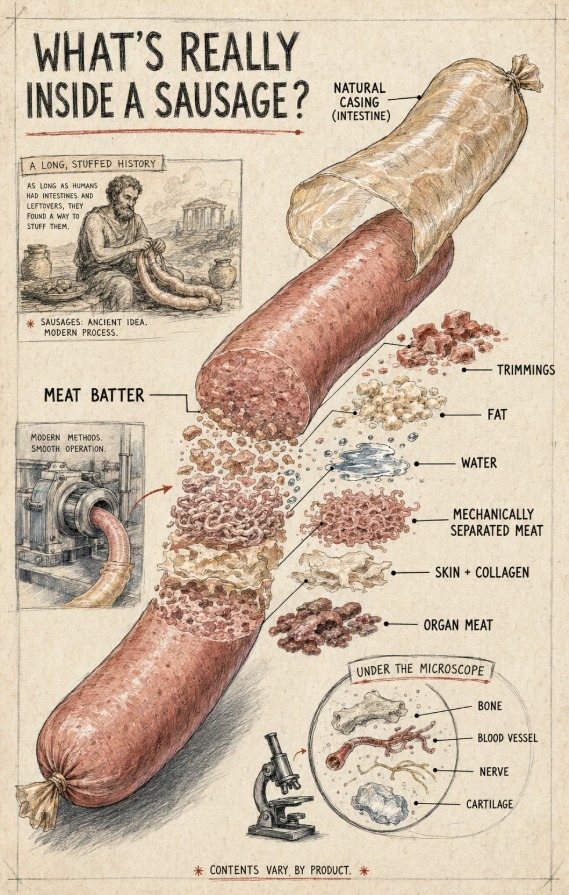
About 3,000 BCE, someone in ancient Sumeria looked at a pile of leftover animal scraps and had what can only be described as a moment of questionable inspiration. They ground the scraps up, mixed them with fat and salt, and stuffed the whole thing into the animal's own intestines.
Which is exactly as disgusting as it sounds.
And yet, somehow, it caught on.
By 800 BCE, sausages were so culturally embedded that Homer mentioned them in The Odyssey.
Odysseus himself, on the eve of his great final battle, is described tossing and turning in bed like a man trying to roast a blood sausage over a fire, eager to have it done. One of the earliest metaphors in all of Western literature compares a warrior-king to a guy impatiently grilling a tube of animal blood over hot coals.
The Romans, naturally, took things further.
They stuffed sausages with pine nuts and spices, served them at festivals, and carried the recipe across every province of their empire. In 424 BCE, Aristophanes wrote The Knights, an entire Athenian comedy built around a sausage-seller who outsmarts a corrupt politician to win the favour of the people. That's right. One of the oldest surviving comedies in Western theatre has a sausage vendor as its hero.
But none of that is what ruins your appetite.
The casing does that.
That smooth, slightly chewy skin you bite through when you eat a sausage? The one that gives it that satisfying snap?
It's intestine.
Specifically, the sub-mucosa layer of a pig's small intestine, scraped clean, flushed with salt water, and trimmed of its fat. (OMG)
Sometimes sheep. Sometimes beef. The industry calls them "natural casings," which is technically accurate in the same way that calling a tsunami "natural water movement" is technically accurate.
To be fair, they work extraordinarily well.
The collagen in the intestinal wall gives the casing strength and elasticity. It's breathable, which allows smoking and curing, and it's both edible and biodegradable. From a pure engineering standpoint, an animal intestine is a nearly perfect container for ground meat.
But explaining collagen engineering to a three-year-old doesn't really soften the blow.
And that's just the casing.
The filling is where things get properly interesting.
The industry word for the main ingredient is "trimmings."
Trimmings sound harmless.
They sound like something you'd find in a craft store, maybe next to the ribbon.
In practice, trimmings are the bits of meat cut away after all the good cuts have already been taken. The scraps. The odds and ends. The parts that, if you saw them loose at a butcher's counter, you would politely pretend not to notice.
According to the United Nations Food and Agriculture Organization, the raw materials for products like hot dogs include, and I'm quoting their exact category labels here, "lower-grade muscle trimmings, fatty tissues, head meat, animal feet, animal skin, blood, liver, and other edible slaughter by-products." Ewwwwwwwwwwwwwwwwww....
Edible slaughter by-products.
That's an actual food category. Someone typed that phrase, presumably with a straight face, into an official UN document.
But it gets better.
When a group of researchers decided to put 8 different brands of hot dogs under a surgical pathology microscope, what they found was extraordinary.
The actual skeletal muscle, the part you'd normally call "meat," made up a median of 5.7 percent of the cross-section. In some brands, it was as low as 2.9 percent.
The rest? All 8 brands contained bone fragments. Did you know that?
All 8 contained blood vessels. 7 out of 8 contained peripheral nerve tissue. Half contained cartilage. And the majority of what they saw, by far, was fat.
Food safety regulations also permit sausage manufacturers to include organ meats like livers and kidneys, lymph glands, and animal skin. The researchers concluded, with what I can only imagine was a very long pause at the keyboard, that "hot dog ingredient labels are misleading."
These trimmings get ground up.
Then ground up some more.
Then blended at high speed into something the industry calls a "meat emulsion," though food scientists will tell you "meat batter" is probably more honest. This thick pink paste gets pumped into casings and cooked until it firms up into the familiar tube-shaped object sitting cheerfully on your plate.
And if the trimmings aren't enough, there's also mechanically separated meat. This is produced by taking the bones that still have small bits clinging to them and forcing those bones through a sieve under high pressure. The result is a paste. A paste made from whatever was too stubborn to fall off a skeleton voluntarily.
About 30 percent of a typical hot dog is pure fat. Another significant chunk is water. The rest is meat, in the broadest possible interpretation of that word.
Oh, and one more thing.
The word "botulism," that potentially fatal form of food poisoning? It comes from the Latin word botulus. Which means sausage. A German doctor named Justinus Kerner first described the disease in the early 1800s after a wave of deaths from poorly preserved sausages in southern Germany. Before anyone gave it a proper medical name, they just called it "sausage poison."
So one of the deadliest foodborne illnesses in history is literally named after this food.
And still. We eat them.
Every civilization, independently, arrived at the same conclusion.
The Sumerians stuffed intestines with salted scraps.
So did the Romans.
So did the Chinese, who turned pork, soy sauce, and rose wine into lap cheong.
The Germans and the Spanish and the Italians each developed dozens of their own versions, all built on the same beautiful, disgusting premise.
If you grind it up fine enough, season it properly, and stuff it into a tube, it's magnificent.
There's something almost admirable about that. The sausage is the ultimate act of human refusal to waste anything. It's five thousand years of people looking at the parts nobody wants and saying, "I can make something of this."
Trinity doesn't buy it. Elias doesn't either. They have very long memories and very little tolerance for meat batter.
But the rest of the world eats over a hundred billion dollars' worth of sausages every year. And almost none of them ask what's inside.
Which, if you think about it, might be the wisest approach of all.