The Origin, 5 October 2026
In 1980, a team from Harvard looked at Singapore's plans for an MRT and gave some advice.
Don't build it.
Buses would do the job. And if Singapore really insisted on a train, accounts of their report say, one line could be enough.
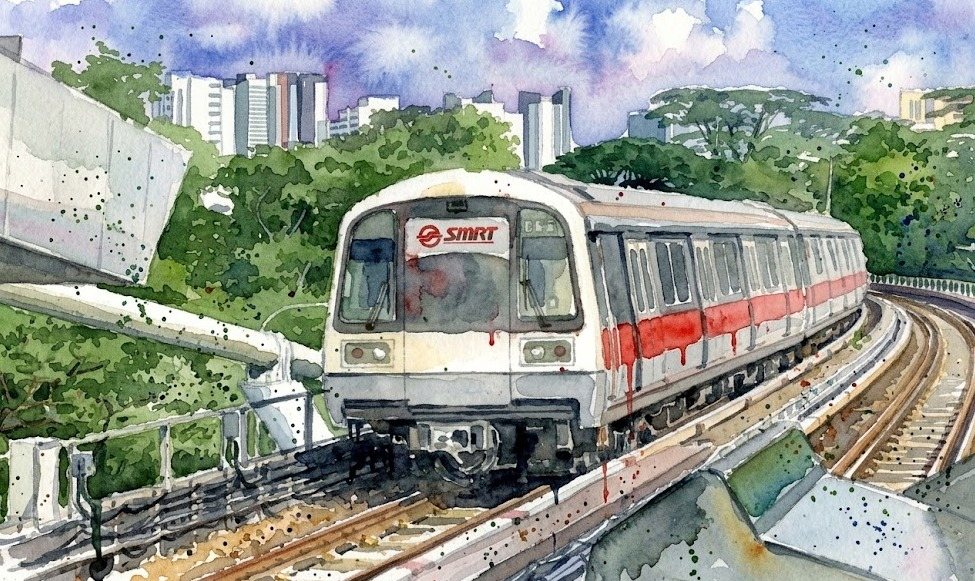
Today Singapore has six MRT lines, more than 140 stations and over three million rides a day.
If you're reading this on a train right now, you're sitting inside the thing the experts said Singapore didn't need.
This is the story of the argument that nearly stopped it.
It started with a forecast.
In 1967, a planning study run by the Singapore government and the United Nations Development Programme looked 25 years ahead. It planned for a population of about 3.4 million and proposed a 32-kilometre mass rapid transit system running by 1992.
One of the people seconded to that project was a young architect named Ong Teng Cheong.
He'd met his future wife, Ling Siew May, when he was 16 and she was 15. They both went on to study architecture in Adelaide. Then a Colombo Plan scholarship took him to the University of Liverpool for a master's in town planning. By 1967 he was 31.
Remember that name.
Over the next decade, consultants studied the idea in three phases. The first two both pointed the same way. Rail.
So you'd think the decision was easy.
It wasn't even close to easy.
Then the sceptics weighed in.
Deputy Prime Minister Goh Keng Swee, Singapore's first finance minister and one of its sharpest economic minds, was among the most prominent doubters. He questioned whether Singapore should spend billions on rail at all.
It was Goh who brought in the Harvard team.
Led by Professor Kenneth Hansen, they concluded that an MRT was unnecessary. A comprehensive, high-performance bus system could meet Singapore's needs. World Bank experts who were consulted backed that assessment.
The argument became known as the Great MRT Debate.
It played out in Parliament and in the papers. In October 1980, it went all the way to national television, with the Harvard team facing off against MRT supporters from the transport consultants Wilbur Smith.
Picture a country so small it debated a train line on TV.
Ong Teng Cheong didn't back down.
By then he was Minister for Communications. He argued that buses would have to fight for road space on an island with almost no land to spare, and that rail would support economic growth, investor confidence and land values.
The government kept studying the alternatives. In 1981, the Comprehensive Traffic Study concluded that rail should form the backbone of the system alongside buses, and that buses alone couldn't handle future congestion.
Even then, the doubts didn't go away. In December 1981, Trade and Industry Minister Tony Tan argued the timing was wrong. The construction sector was already stretched, and public housing deserved priority.
On 28 May 1982, at the Singapore Institute of Architects' annual dinner, Ong announced the decision. Singapore would build the MRT, at an estimated cost of S$5 billion, and the government would pay for it.
It was the largest public works project the country had ever taken on. And it was announced by an architect, at a dinner full of architects.
Then they had to actually build it.
Ground was broken on 22 October 1983 at Shan Road, off Balestier Road.
The trains came from Japan, built by a consortium led by Kawasaki Heavy Industries. The first MRT trains were formally delivered at Bishan Depot on 8 July 1986.
On 7 November 1987, the first stretch opened. About six kilometres and five stations, from Yio Chu Kang to Toa Payoh.
Ong Teng Cheong took the inaugural ride.
On 12 March 1988, Prime Minister Lee Kuan Yew officially launched the system. The original network was finished in July 1990. Sixty-seven kilometres and 42 stations.
The target had been 1992. They finished two years early, and about 15 percent under the S$5 billion budget.
The stations were built for more than trains.
In 1983, Singapore began hardening nine underground MRT stations so they could serve as public shelters. Today, the Singapore Civil Defence Force says 60 underground stations can be used as shelters in wartime.
They have protective blast doors, decontamination chambers and ventilation systems. When activated, they can supply clean air, water and electricity.
Most commuters walk past those doors every day without a second look.
In 2003, the North East Line opened. The Land Transport Authority calls it the world's first fully automated, driverless underground heavy rail line.
There's no driver up front. The trains are run from a control centre.
The stations hide one more thing in plain sight. Hundreds of artworks now sit across the network under a programme called Art in Transit, which the LTA calls Singapore's largest public art showcase.
You've probably leaned against a few of them while waiting for the doors to open.
It was never really trains versus buses.
The real question was whether Singapore needed rail badly enough, and soon enough, to justify spending an unprecedented S$5 billion.
The sceptics' concerns about cost and timing weren't unreasonable. Rail is still enormously expensive to build and run.
But the government decided it was worth it. Today the network stretches about 200 kilometres and carries over three million rides a day.
The government's target is for eight in ten households to live within a 10-minute walk of a train station by the 2030s.
And it shows up in what homes are worth. One 2021 analysis found that HDB flats within 500 metres of an MRT station sold for about 8 percent more than flats farther away.
The project that looked too expensive in 1980 is now priced into the flat you live in.
Ong Teng Cheong went on to become Singapore's first elected President.
He became popularly known as the People's President.
In one of those neat little twists history likes, Tony Tan became President too, in 2011.
Ong served one term, from 1993 to 1999, and chose not to run again. Siew May, the girl he'd met at 16, died about a month before his term ended.
He died in 2002, at 66.
He'd been there in 1967, when the MRT was a line in a planning report. Fifteen years later, he was the one who announced it would be built.
The Harvard team recommended buses. If rail was built at all, one line might do.
Next time you tap in at the gantry, look up at the network map and count the MRT lines.
There are six.
And they're still building.