The Figure, 3 May 2026
Before he died, Wee Kim Wee made one request.
He asked to be cremated and for his ashes to be placed at Mandai Columbarium, with ordinary citizens, instead of at Kranji, where Singapore's dignitaries are usually buried.
That tells you everything about who he was.
But let me tell you the rest anyway.
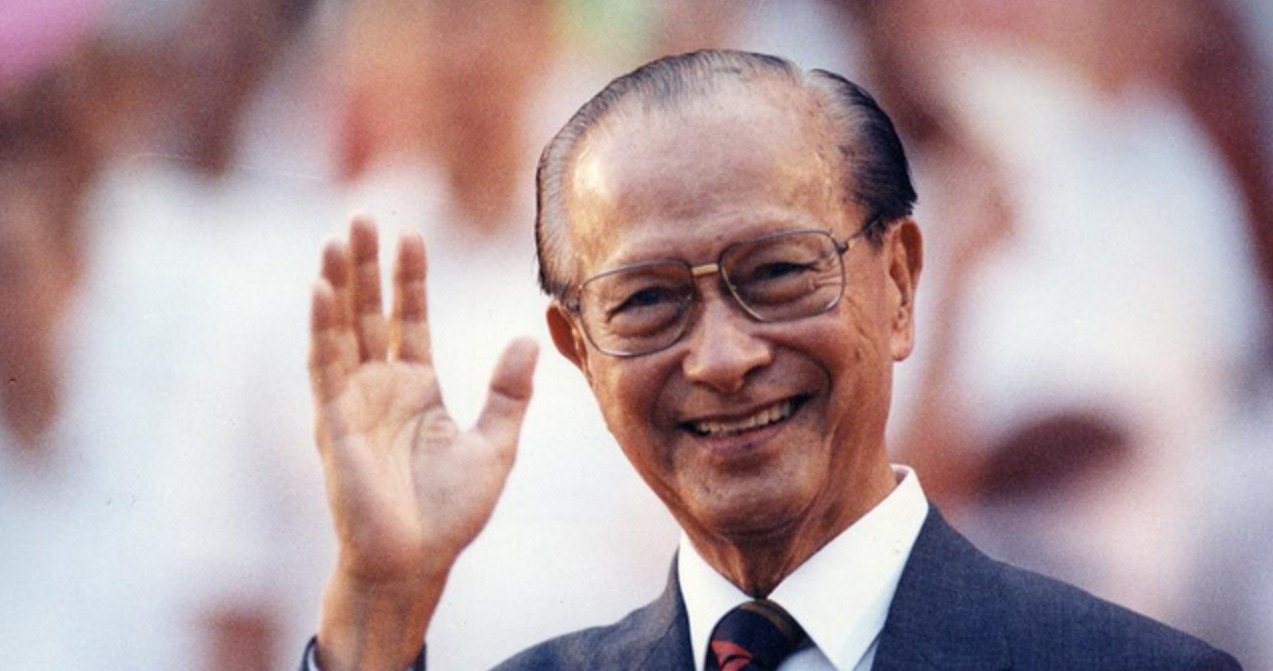
Wee Kim Wee was the fourth President of the Republic of Singapore, serving from 1985 to 1993.
He had no university degree.
He started his career at the age of 15 as a clerk in the circulation department of the Straits Times, sorting and counting newspapers.
And before any of that, he was a boy whose father went blind when he was six and died when he was eight.
His father, Wee Choong Lay, was a ship's purser.
His mother, Chua Hay Luan, raised the family alone after her husband's death, and she too passed away when Kim Wee was just 19.
By the time he was a young man, both parents were gone, and there was no money for further education. He left Raffles Institution after two years and went to work.
He spent five years in the Straits Times circulation department before being transferred to advertising, where he worked for another three or four years.
Then he became a reporter, starting with sports: soccer, badminton, table tennis, basketball. In his younger days, he was more than a sports reporter.
He was a sportsman himself.
In 1932, he co-founded the Useful Badminton Party with 13 other players.
In 1937, he won the Singapore Junior badminton championship singles title, and he went on to serve as secretary and later president of the Singapore Badminton Association.
A clerk who counted newspapers.
A boy who lost both parents before he was 20.
A badminton champion.
None of this sounds like the beginning of a president's story. That's because it wasn't supposed to be.
In early 1941, he resigned from the Straits Times after being passed over for a promotion he felt he deserved.
He joined the United Press Associations, the American wire service, just months before the Japanese invaded.
During the Occupation, he struggled.
He sold mosquito coils from a stall in Kampong Bahru.
He worked clerical jobs at Japanese military establishments to survive. After liberation, an American UPA correspondent named Charles McQuown-Wright found him and pressed S$50 into his hand to keep him going.
He stayed at UPA through the 1950s, eventually becoming the office manager and chief correspondent for Singapore, Malaya, Borneo, and Brunei.
Then in 1959 the Straits Times wanted him back. They offered him the position of Deputy Editor, and he returned to the paper that had once passed him over.
Then came the scoop that made his name.
In 1966, during the Konfrontasi, Wee Kim Wee became the first Singaporean journalist to enter Jakarta.
He interviewed Lieutenant General Suharto and Foreign Minister Adam Malik, and reported their intention to end the confrontation with Malaysia.
He broke the story on the front page with Suharto's own words: "Peace: the sooner the better."
Singaporeans and Malaysians learned for the first time, through a journalist from the Straits Times, that the conflict was going to end.
He also covered the civil war in the Belgian Congo alongside a Malaysian peacekeeping force, accompanied Prime Minister Lee Kuan Yew on official visits to Indonesia and Eastern Europe. And in 1963 managed to interview a Sulu pirate chief while on assignment in Malaysia.
He was, by any measure, one of the finest journalists Singapore has ever produced.
In 1973, the government offered him the post of High Commissioner to Malaysia, a position he was supposed to hold for three years but ended up holding for seven...
And by the end he was dean of the diplomatic corps in Kuala Lumpur. From there, he became Ambassador to Japan and later to South Korea, then was appointed Chairman of the Singapore Broadcasting Corporation.
In 1985, Parliament elected him President of Singapore.
He was 69 years old.
He had no political experience, no party affiliation, and no degree.
What he had was something that couldn't be credentialed: the trust of ordinary Singaporeans who recognised him as one of their own.
He was known for attending events that previous presidents had skipped, showing up at community centres, schools, and neighbourhood functions where he shook hands with everyone, remembered names, and asked about children.
PM Lee Hsien Loong later described his handling of Singapore's relationship with Malaysia as marked by "skill and sensitivity," a product of his years as a journalist who knew how to listen before he spoke.
In 2004, he published his autobiography, Glimpses and Reflections. He donated half a million dollars from the royalties to eight charities.
That was the last public act of a man who had spent his life giving without keeping count.
Wee Kim Wee died of prostate cancer at his home in Siglap on May 2, 2005, at the age of 89.
The tributes were quiet, like the man.
NTU renamed its School of Communication Studies the Wee Kim Wee School of Communication and Information.
SMU renamed its Centre for Cross-Cultural Studies the Wee Kim Wee Centre, and NUS had already conferred on him an honorary Doctor of Letters in 1994, the degree he'd never had the chance to earn.
And his ashes went to Mandai.
Not Kranji. Mandai.
With the ordinary citizens he'd spent his life serving.
============
Wee Kim Wee...
His father went blind when he was six, died when he was eight, and his mother was gone by the time he was 19.
He left school at 15.
He counted newspapers.
He sold mosquito coils during the Occupation.
He pressed on, not because he had a plan or a patron or a pedigree, but because he had something that doesn't show up on a CV: the ability to make every person he met feel like they mattered.
He became a reporter, then the best journalist in the country, then a diplomat, then the President.
And when it was over, he asked to be placed at Mandai with the people he'd served, not at Kranji with the people he'd become.
That's the difference between a head of state and a People's President.
The head of state wants to be remembered, but the People's President just wants to go home.