Founders, 26 June 2026
TWG Tea wasn't founded in 1837.
It was founded in 2008.
For years, the number "1837" appeared on every tin, every menu, every salon wall. Maranda Barnes had found the date while researching Singapore's history at the National Library. It was the year Singapore's Chamber of Commerce was established, when the island first became a trading post for teas and spices.
She put it on the logo, and millions of people assumed they were buying from a heritage brand nearly two centuries old.
That single design decision was the most effective piece of branding in Singapore's business history. It worked so well that the company eventually removed it from its packaging because too many people believed it was the founding year.
Let that sink in: they took their own branding down because it was TOO convincing.
Here's the real story.
Taha Bouqdib is Moroccan. He grew up in Morocco, where tea is woven into daily life, where pouring mint tea for a guest is an act of welcome that goes back centuries. His father was the head of security for the King of Morocco. Taha was expected to follow that path.
He chose tea instead.
He moved to Paris at 18 and spent the next two decades building expertise in the fragrance and tea industries. He became one of France's most knowledgeable tea experts, with over 14 years of experience sourcing directly from tea estates across the globe and 20 years in fragrance.
Maranda Barnes is from Chicago. She was a concert violinist from the age of three, studied at the Conservatoire de Paris and the American University of Paris, and worked in the luxury fragrance industry before discovering tea.
They met in a Paris tea salon.
Of course they did. The co-founders of the world's most famous luxury tea brand met over a cup of tea. They married in Paris in 2003.
At the time, Taha was certain he would never leave Paris. Then an opportunity to build a tea brand in Asia presented itself, and in 2007 they visited Singapore for the first time on holiday and fell in love.
"The people I met were very impressive," Taha told Tatler. "For me, they are the soul of this country. I felt that I could build an extremely strong base here and grow the brand very quickly."
Three months later, they had relocated from Paris.
In 2008, TWG Tea opened its first salons at Republic Plaza and ION Orchard with US$10 million in initial capital. TWG stands for The Wellbeing Group, and they wrote no business plan.
"Founding the company was more a personal decision than something with a business plan," Maranda said. "Neither of us drafted one."
Within the first year, Singapore Airlines was serving TWG Tea in its Suites, First Class, and Business Class cabins. By 2009, Dean & Deluca in New York was selling it. By 2010, they'd opened their first overseas salon in Tokyo. By 2012, they'd broken even.
The brand now offers over 1,000 tea varieties sourced from 47 tea-producing regions, operates 70+ salons and boutiques across Asia, Europe, the Middle East, and North America, and generates an estimated US$90 million in annual revenue.
From a country that doesn't grow a single tea leaf.
That's the detail most people miss.
Singapore produces zero tea.
TWG is a luxury tea empire headquartered in a nation with no tea plantations, no tea-growing climate, and no tea tradition of its own.
The brand is built entirely on curation, blending, sourcing, and an experience so refined that customers from China, the world's largest tea-producing country, buy TWG over their own local options.
=========================
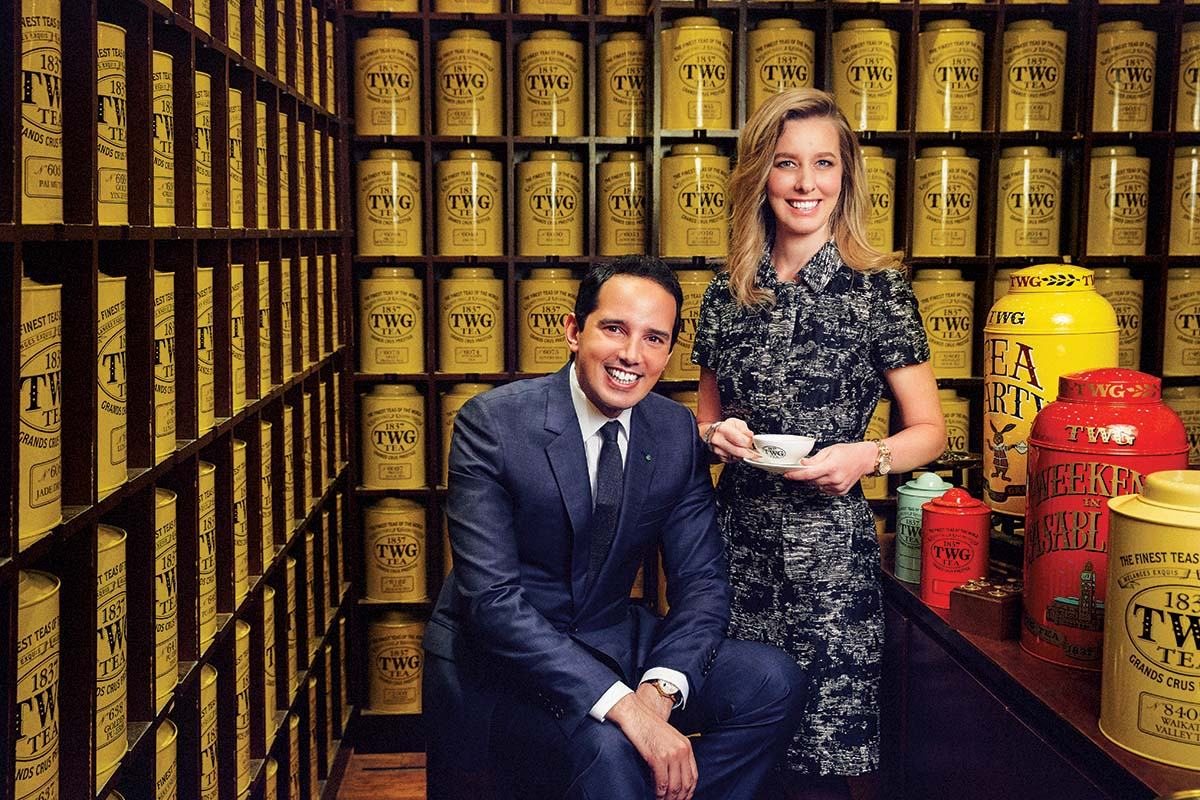
Taha Bouqdib and Maranda Barnes.
They understood something most founders don't: you don't need to make the raw material to own the category.
Singapore doesn't grow tea.
It doesn't need to.
What Singapore does better than almost anywhere is trade, curate, and present. TWG is the logical extension of what this island has been doing since 1837, taking products from around the world and adding value through selection, quality control, and presentation.
The "1837" was never a lie.
It was a thesis.
Singapore has been a tea trading post for nearly 200 years, and TWG positioned itself as the modern expression of that history.
The fact that critics called it "fake luxury" while customers kept buying tells you everything about the gap between what the industry thinks matters and what consumers actually feel. The date did its job. Then it was retired.
A Moroccan tea expert whose father guarded a king, an American violinist who worked in perfume, a date found at the National Library, and a brand built in a country that grows no tea but is loved by customers from countries that grow all of it.
The best branding doesn't describe what you are.
It describes what you mean.