Founders, 6 August 2026
Sim Wong Hoo sued Apple. Apple paid US$100 million.
Not a quiet backroom deal. Creative Technology sued Apple for alleged patent infringement. Apple countersued. Five lawsuits were pending between the two companies. Then Apple agreed to a public settlement: US$100 million paid to Creative for a licence to the disputed patent.
But the story before the lawsuit is the part most people don't know.
Sim later recalled that Steve Jobs visited a Creative trade-show booth and liked what he saw. According to Sim, Jobs invited Creative's team to Apple's headquarters to discuss a potential collaboration.
The discussions came to nothing.
Then Apple launched the iPod, and the navigation interface that let users drill from artist to album to song bore a resemblance to a system Creative had already filed a patent application for.
"Steve came to our booth, saw our products and liked the product," Sim told CNBC. "He saw the future of Apple there."
Sim Wong Hoo was born in 1955 into a Zhao'an Hokkien family in Singapore. He was the tenth of twelve children and grew up in a kampung in Bukit Panjang. He attended Bukit Panjang Government High School, then earned a diploma in electrical and electronic engineering from Ngee Ann Technical College, now Ngee Ann Polytechnic, in 1975.
After National Service and a year in the private engineering sector, he founded Creative Technology in July 1981 with modest initial capital, widely reported at around S$10,000, alongside his schoolmate and childhood friend Ng Kai Wa. Their first location was a computer shop at Pearl's Centre in Chinatown.
Among Creative's earliest products was an add-on memory board for the Apple II. Its first major development project was a bilingual computer adapted for the Singapore market, with audio capabilities that allowed it to produce speech and melodies in English and Chinese.
That audio work led to the product that changed the PC industry.
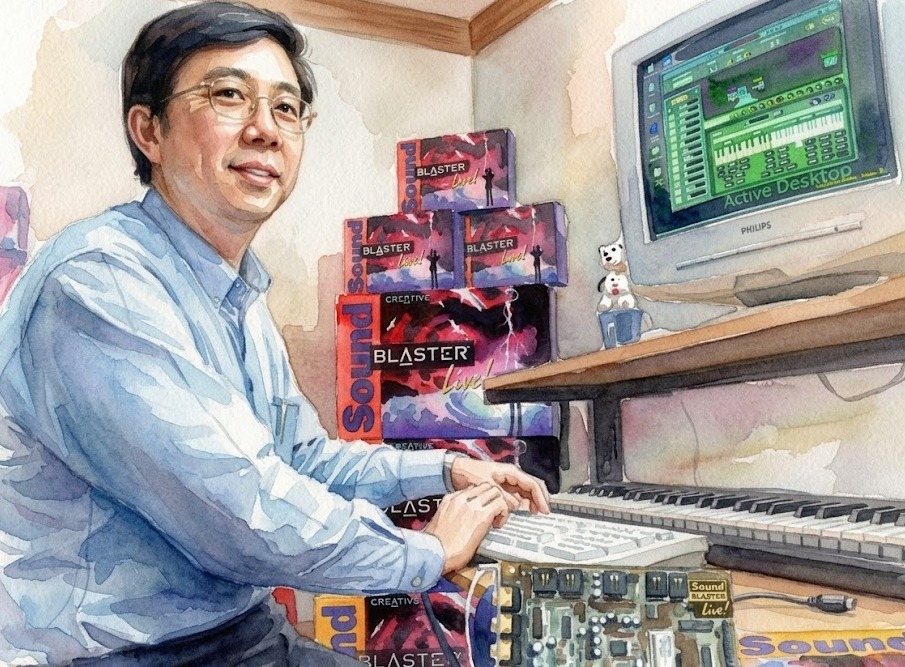
Creative went through several products and pivots, including the Creative Music System and the Game Blaster, before launching the Sound Blaster in November 1989.
Before add-on sound cards, most IBM-compatible PCs relied on rudimentary internal-speaker beeps. Products like AdLib had brought synthesised game music, but Sound Blaster combined broad compatibility, music synthesis, and digitised audio in a package that became the industry standard.
Creative's revenue went from US$5.4 million in 1989 to US$658 million in 1994 and crossed US$1.2 billion the following year. Creative says more than 400 million Sound Blaster units and audio solutions were sold worldwide.
In 1992, Creative became the first Singapore company listed on Nasdaq, and by 2000 Sim had become Singapore's youngest billionaire at the age of 45.
Then came the iPod.
Creative had entered the portable MP3-player market before Apple, launching its Nomad line in 1999 and a hard-drive jukebox more than a year before the iPod appeared in October 2001.
But Apple's iPod and iTunes ecosystem eventually overwhelmed Creative's portable-player business.
The company that had set the standard for PC audio was being overshadowed by the company that redefined how people bought and listened to music.
In 2006, Creative sued Apple, alleging that the iPod's navigation interface infringed a patent Creative had recently been granted. Apple countersued. The dispute ended when Apple agreed to pay Creative US$100 million for a licence to the patent.
A Singaporean inventor from a Bukit Panjang kampung had taken on a rapidly growing American technology giant and walked away with a nine-figure settlement.
Even after Creative's market dominance faded, Sim never stopped inventing.
In 2018, Creative unveiled Super X-Fi at CES, where it won a Best of CES award, with a broader product launch following in 2019. Sim said the technology took 20 years and US$100 million to develop. It recreates the spacious soundstage of a multi-speaker system through personalised headphone processing. "This is 100 times, 1,000 times more exciting than the Sound Blaster," he told Yahoo Finance.
Sim Wong Hoo never married.
He ran Creative Technology as founder, chairman, and CEO for 42 consecutive years. He renamed his charitable foundation the Sim-Tan Siok Kee Foundation after his mother's death in 2006. He received the Public Service Star in 2001.
He died on 4 January 2023 at the age of 67.
Deputy Prime Minister Heng Swee Keat wrote: "Sim Wong Hoo made it in an era when Singapore was not known for innovation or entrepreneurship. His success serves as inspiration for Singapore startups that followed."
Here's what I think about when I think about Sim Wong Hoo.
400 million Sound Blaster units sold. That's the number that matters. Not revenue, not valuation, not market cap. 400 million audio products designed by a man from a kampung who started with a computer shop in Chinatown.
He entered the portable music player market before Apple did.
He took Apple to court when he believed they'd used his navigation system.
He spent 20 years and US$100 million on a technology he believed could surpass the Sound Blaster. He never married, never retired, never stopped.
"Singapore can be a tough environment for entrepreneurship," he once said. "But if you can get by the tough part, you become very tough."
Tenth of twelve children. Kampung in Bukit Panjang. A computer shop in Chinatown. And eventually, 400 million audio products and a US$100 million settlement from Apple.
He gave computers their voice. Singapore should remember his.
If you run a business, 2 things from this story are worth thinking about...
1. Creative had filed a patent application covering its navigation system before the iPod launched, and years later that patent became the basis of a US$100 million settlement. Smaller companies should identify valuable intellectual property early and decide whether patents, trade secrets, or other protections best fit the business. Not every innovation needs a patent, but the ones that do can define your future.
2. Creative's breakthrough didn't come from its first product. The company went through memory boards, bilingual computers, the Creative Music System, and the Game Blaster before Sound Blaster became the global standard. Sim carried useful technology from one product into the next until something caught. If your current product isn't the one, the skills you're building might power the one that is.
And if you're not a business owner, this story still has something for you.
Sim Wong Hoo didn't graduate from NUS or NTU but had a diploma from Ngee Ann Polytechnic. He was the 10th of 12 children from a kampung who started a computer shop in Chinatown with around S$10,000.
Your starting position doesn't determine where you end up. And sometimes the most important ingredient isn't capital or credentials.
It's the refusal to stop.