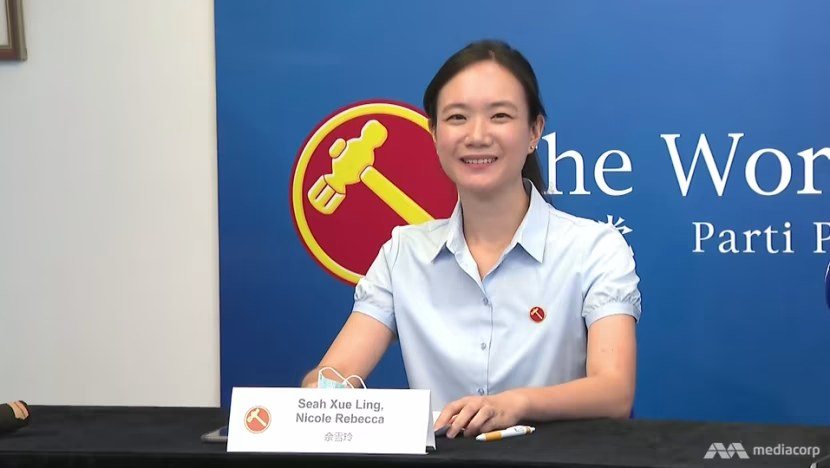
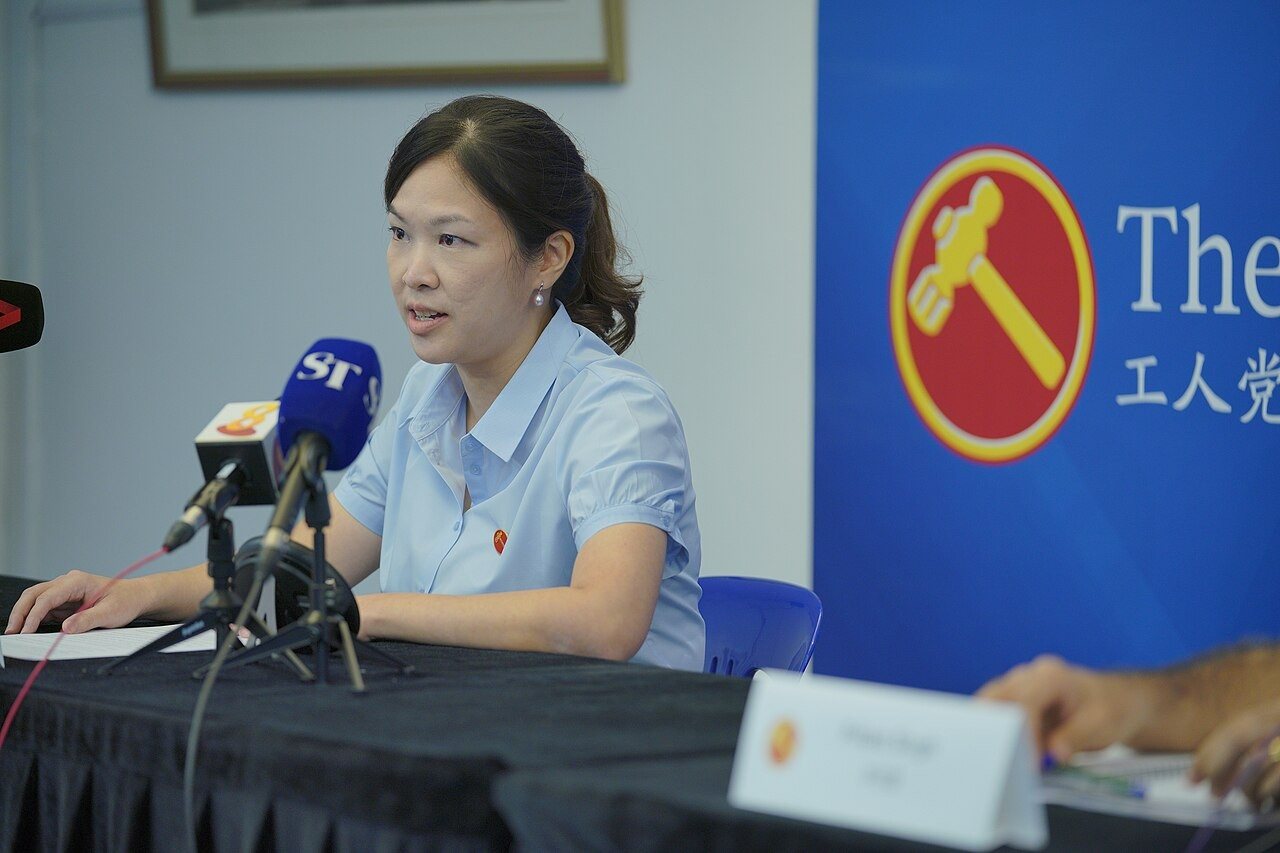
The Figure, 14 June 2026
He Ting Ru met her husband at a party.
Not the kind with balloons and a DJ.
The Workers' Party.
At a rally in January 2013, during the Punggol East by-election, she spotted a man on stage and formed an immediate impression. "Wow, this bald guy likes to shout."
He already knew who she was.
They'd both been volunteering with the party, doing house visits in HDB corridors, knocking on doors that sometimes didn't open. He'd watched how she spoke to the residents who did. How she listened without rushing to the next unit. His impression of her was nothing like hers of him. "I liked her. I respected her. I found her very caring and empathetic towards people."
Two years later, they ran on the same team.
Marine Parade GRC, the 2015 general election. Five Workers' Party candidates against a PAP slate that included former Prime Minister Goh Chok Tong. The result came in at 35.9%.
They lost.
And then they got married.
That's the He Ting Ru story in a nutshell, if you wanted to tell it quickly. A woman who keeps choosing the harder version of every decision available to her, and a man who keeps choosing her.
But the story doesn't start at the rally.
It starts much earlier, on a path so clean and well-lit you could walk it with your eyes closed.
She went through CHIJ Saint Nicholas Girls' School, then Raffles Junior College, and then landed a place at the University of Cambridge, where she read Natural Sciences. Not law. The sciences. How things work at the smallest, most fundamental level.
After Cambridge, she switched tracks. Completed a Graduate Diploma in Law, qualified as a solicitor in England and Wales, and joined Clifford Chance. One of the five "Magic Circle" firms, the most prestigious tier of law practice in the UK. She worked in London and then Frankfurt on cross-border corporate matters. After that, she moved to a European financial institution in Singapore as a derivatives lawyer. The kind of work where the numbers have too many zeros and the hours have too few.
If you drew a straight line from where she started to where she was supposed to end up, it would look like every Singaporean parent's dream. Convent school, top JC, Cambridge, Magic Circle. Career sorted. Fly the flag from London and come home for Chinese New Year.
You know someone on this path. You might have walked parts of it yourself. And you know the unspoken rule that comes with it: don't risk what you've built.
She came home for good in 2011 instead.
Something had shifted while she was away. Singapore felt different, though she couldn't pin it to one thing. And that year, something happened that she didn't expect to care about as much as she did. The Workers' Party won Aljunied GRC. Chen Show Mao, a man who had built one of the most successful legal careers in Asia, had stepped forward to run for the opposition.
The principle of it stuck with her more than the politics. That someone with everything to lose would choose to stand in a gap because they believed the gap shouldn't exist.
So she did something that nobody on her trajectory was expected to do. She wrote to the Workers' Party and asked how she could help.
"I didn't think of it as a political statement or a career. I just wanted to use my skills to help residents."
She showed up. For four years, she volunteered. Walked corridors in the Paya Lebar division of Aljunied GRC. Knocked on doors. Learned the difference between what people tell you when you're a lawyer across a conference table and what they tell you when you're standing in their kitchen on a Saturday afternoon.
By 2015, the party asked her to run as a candidate in Marine Parade GRC. That's when her family's concern sharpened. Her parents asked if she'd be "fixed." The word didn't need explaining. Every Singaporean over 40 knew exactly what it meant.
She said yes anyway.
On that same five-person team was Terence Tan. The bald guy who liked to shout. Up close, he was different from the stage version. Direct. Warm. He watched how she handled the long campaign days, the heat sticking to the back of your polo tee at a hawker centre at 2pm, the polite rejection at certain doors, the way she kept walking to the next one.
They got 35.9%. Marine Parade stayed with the PAP.
The morning after an election loss in Singapore, nobody gives you time to grieve. You go back to your day job on Monday. Your colleagues know. Some of them pretend they don't. Your phone is full of messages from friends who don't quite know what to say, so they say something general about being proud. And you sit at your desk and decide whether you're going to do this again.
Ting Ru and Terence decided yes. Somewhere between that loss and January 2016, they also decided something else. They got married.
He joked about it afterwards. "When you're in the opposition party, no one wants to marry you. So you have to marry each other."
The laugh line gets shared a lot. What sits underneath it is heavier. In a country where your political affiliation can follow you into job interviews and business meetings, choosing opposition is not a weekend hobby. It's a bet you place with your whole life. And they placed it together.
By 2020, they had two sons. Ages two and three. And both of them were running again.
Different constituencies this time. Ting Ru led the WP team in the newly created Sengkang GRC. Four candidates. She was the only one who'd ever stood for election before. Alongside her were Jamus Lim, an associate professor of economics who was 44; Louis Chua, an equity research analyst who was 33; and Raeesah Khan, a 26-year-old activist.
Across from them, the PAP fielded a team led by Ng Chee Meng, a minister in the Prime Minister's Office. Three political office-holders on one side. Zero on the other.
Ting Ru's parents took care of the boys while both she and Terence campaigned across different ends of the island.
On the night of July 10, 2020, Sengkang GRC fell to the Workers' Party.
The margin was 4,898 votes. 52.12% to 47.88%. A margin so thin you could feel the wind from the other side. And it was the first newly created GRC in Singapore's history to fall to the opposition.
Ting Ru became the Chairwoman of Sengkang Town Council.
In Parliament, she picked her ground with the precision of someone who'd spent years studying how systems work from the inside out. Her maiden speech was about elitism and the perception of social mobility, about the invisible wall between earning your place and believing you deserve it.
She told a story about a volunteer from a disadvantaged background who'd earned his way to law school and a training contract at a prestigious firm.
By every external measure, he'd made it.
But the feeling hadn't caught up. He still couldn't shake the sense that the door would close on him if he stood there too long.
A Cambridge-educated lawyer standing in Parliament under the Workers' Party banner probably knew exactly what that feeling was.
Over the next few years, she pushed for something that sounded small but wasn't.
Regulation of mental health practitioners.
Unqualified individuals were advertising counselling services on platforms like Carousell.
People seeking help were being exposed to people unequipped to give it. She asked the government to enforce standards, to protect the vulnerable. She kept asking.
By 2025, the Ministry of Health agreed.
Psychologists would be required to register to practise. She called it "a small but important win."
That phrase tells you something about how she measures progress. She counts in inches, not headlines.
And then, in January 2024, Terence quietly left the Workers' Party.
Not because he'd stopped believing.
Because their three sons were all under seven, and both parents being consumed by politics was more than the family could sustain.
He wanted to support his wife, spend more time with his children, and focus on building his own legal career at Robertson Chambers. Both of them had looked at the same equation and understood that only one could keep going at full speed.
One parent steps forward. The other steps back. Not because the second one gave up. Because someone has to be home when the boys wake up.
In the 2025 general election, Ting Ru's team held Sengkang with 56.32% of the vote. The margin tripled to 14,942 votes. A constituency won by a whisper in 2020 was held by a roar in 2025.
She ran that campaign while Terence held the family steady behind her.
People love to tell the Sengkang story as a political story.
The night the opposition shocked Singapore. The young team that beat the ministers. And that version is true enough.
But there's another version running underneath it, quieter and harder to share at kopitiam, because it's not about politics at all.
Two lawyers who met at a party, fell in love while losing an election, built a family while building a constituency, and then looked at each other and figured out that only one of them could keep carrying both.
"When you're in the opposition party, no one wants to marry you. So you have to marry each other."
What the grin covers is the part that comes after. You marry each other. You build something. You win. And then one of you steps away from the thing you built together, so the other one can keep building it.
Every couple who's ever run a business, raised kids, or tried to hold two ambitions in the same house knows what that conversation sounds like at the kitchen table after the boys are asleep.
Whose turn is it to carry. Whose turn is it to let go.
That's every marriage that ever meant something.