The Figure, 25 June 2026
6 days.
That's how long it took Nicole Seah to become the most popular politician on Facebook in Singapore.
She was 24 years old. She'd never run for anything. She'd just created her profile in April 2011 after being unveiled as a candidate for the National Solidarity Party.
Within six days, she had more followers than any other politician on the platform. Including Lee Kuan Yew.
She wasn't a lawyer. She wasn't a former minister or an army general or someone with a string of postgraduate degrees.
She lived in a five-room HDB flat with her parents and two brothers in the East. She worked in advertising. She studied at CHIJ Katong Convent, Tanjong Katong Secondary, and Victoria Junior College, where she took theatre and drama for her A-levels. Then NUS, where she did communications and was part of the University Scholars Programme.
She described herself on the day she was introduced as a candidate with a sentence that hit harder than any policy speech.
"I do not have a scholarship background. I never read university overseas. I understand how it feels to be stuck in a crowded train."
In a country where political candidates are usually introduced with a list of credentials that reads like a LinkedIn profile, Nicole Seah showed up with nothing but a voice and a story about an old woman.
She was 17 when the anger started. Delivering food to the needy as a student volunteer, she knocked on a door and found an elderly woman who had a roof over her head but couldn't afford a meal.
"That angered me, because yes, we have provided food for her for that one day, but what is going to happen to her the rest of the days?"
That question followed her from JC to NUS to the Reform Party youth wing in 2009, and then to the NSP in February 2011 after a mass walkout over internal disagreements.
Two months later, she was standing in Marine Parade GRC against a PAP team led by Senior Minister Goh Chok Tong. The first time the GRC had been contested since 1992.
Nearly twenty years of silence, and it was a 24-year-old advertising executive who broke it.
The media called the NSP the "Nicole Seah Party." The four men on her ticket faded into the background. Goh Chok Tong himself complained to the press that it appeared to be a one-woman show.
The comparison with Tin Pei Ling, the PAP's youngest candidate, dominated every headline. Two young women, both first-timers, framed as opposites by a media machine that couldn't resist the contrast.
On polling day, Seah's team got 43.35%.
They lost.
But the PAP's winning share was significantly below their national average, and Goh Chok Tong called the result disappointing. He credited Seah directly.
"She communicated very well. She spoke quite persuasively to the younger people as well as some older people."
When a former Prime Minister names you personally as the reason his vote share dropped, you've done something at 24 that most politicians never manage in an entire career.
And then the six days of fame became years of something else entirely.
The threats started immediately.
Rape threats. Death threats. Her office address was posted online along with the time she usually left work. She was stalked.
"I was paranoid when I left the office, knowing that someone could be watching me."
She lost two jobs. The demands of political life, the house visits, the walkabouts, the constant scrutiny, bled into her professional career until there was nothing left to bleed from.
She suffered a panic attack. She felt, in her own words, like "a fraud."
In 2013, she wrote a raw Facebook post describing how she'd been "derailed" from her larger purpose.
That same year, tabloid media published photos of her with a man named Steven Goh, implying she was dating someone who was married. He was divorced. The implication was factually wrong.
The publications eventually apologised. But the correction never travels as far as the accusation.
She also admitted, publicly, that her endorsement of presidential candidate Tan Jee Say in 2011 had been a "terrible, irreversible mistake," and that she had been "arm-twisted" into it.
That admission cost her something too. Political organisations don't forgive public honesty about internal pressure.
By 2014, she was done.
She resigned from the NSP, calling it "an extremely painful and difficult decision." She moved to Bangkok to work in IPG Mediabrands' Thailand office. She was 27 years old and she was running, not from politics, but from everything that comes with it when you have no institution around you strong enough to absorb the blows.
"This is not a complete departure from politics," she said on the way out.
She meant it.
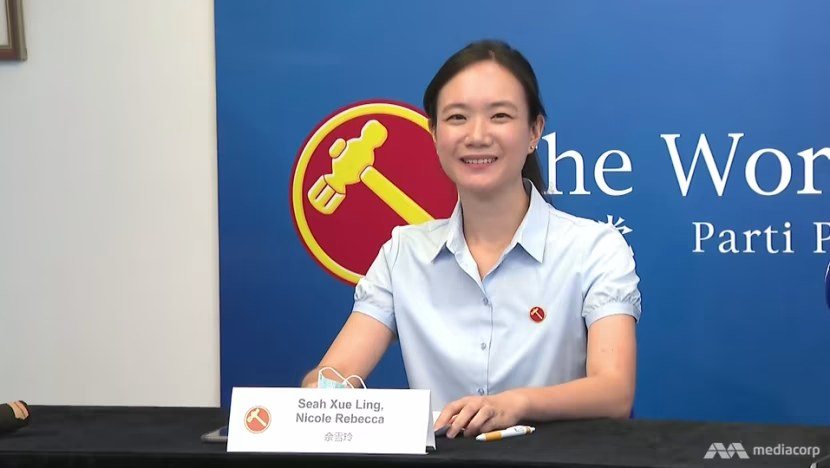
After the 2015 general election, quietly, without press releases or social media announcements, Nicole Seah started volunteering with the Workers' Party.
Not as a candidate or a spokesperson. As what one Mothership writer later described as "the blue-collared, chair-carrying foot soldier of the Workers' Party."
She carried chairs and helped write the WP's 60th anniversary book. She did the ground work that nobody photographs and nobody posts about.
For five years, the most naturally gifted political communicator of her generation folded flyers and walked corridors.
She rose through the party. President of the WP Youth Wing. Elected to the Central Executive Committee.
And when GE2020 was called, she was fielded in East Coast GRC.
Against Deputy Prime Minister Heng Swee Keat.
This time, the infrastructure was different. She wasn't a lone star on an NSP ticket. She was part of a WP system with an established ground network, a brand that voters trusted, and a support structure that could absorb the pressure she'd crumbled under nine years earlier.
The result was 46.59% for the WP.
They lost.
But they came close enough to rattle the DPM. Close enough that Heng Swee Keat had to make a live victory speech that felt more like relief than celebration.
Close enough that if fewer than 4,000 voters had gone the other way, the Deputy Prime Minister would have lost his seat.
Two elections. Two losses.
One at 24 with no infrastructure and nothing but raw talent. One at 33 with the full weight of Singapore's strongest opposition party behind her.
Both times, she came close enough to change the outcome by a percentage point. Both times, the door didn't open.
Then, in July 2023, a video surfaced of Nicole Seah and Leon Perera, a WP MP for Aljunied GRC, holding hands. Both were married to other people. Perera resigned from Parliament and from the party. Seah resigned from the WP the following day.
The political career ended the way the tabloid journalism of 2013 had always wanted it to end. Personally. Publicly. In a way that had nothing to do with policy or conviction and everything to do with being human in a system that doesn't make room for it.
There's a version of the Nicole Seah story that's about a gifted politician who self-destructed.
And some people will read it that way.
But there's a harder version underneath.
She was 24 when the spotlight found her, and there was no structure around her to hold the heat. No party machinery strong enough to shield a young woman getting death threats. No institutional buffer between her and a media cycle that chewed through her personal life without fact-checking and without apology until the lawyers got involved.
She was the best natural communicator in the room. And the room burned her for it.
When she came back, she did the opposite of what anyone expected. She didn't come back as a star. She came back as a foot soldier.
Carried chairs.
Folded flyers.
Wrote a party history book nobody read.
Climbed from volunteer to CEC member the slow way.
And when she ran again, the result improved by three full percentage points, against a Deputy Prime Minister, in a constituency that had never gone to the opposition.
Then the door closed. And this time, she was the one who closed it.
The question Nicole Seah's story asks isn't about talent. It's about timing.
She had more natural political ability at 24 than most MPs develop in twenty years. But ability without infrastructure is a match without a fireplace. It burns the hand holding it before anyone can build a hearth around it.
If you've ever launched something too early, gone viral before the product was ready, or gotten the spotlight before the team and systems were in place to sustain it, you know exactly what six days of fame can cost when the next six thousand days don't have a plan.
The old lady with the roof but no meal is probably gone by now.
The 17-year-old who knocked on her door and got angry isn't in politics anymore.
But the question she asked that day, "What is going to happen to her the rest of the days?", is still the right question.
And nobody in Singapore politics has ever asked it better.