Founders, 3 September 2026
He named the restaurant after a woman who wasn't his wife, wasn't his mother, and wasn't related to him.
In the mid-1930s, a teenager from the Tanjore district of Tamil Nadu arrived in Singapore.
Murugiah Rajoo found work as a shop assistant at a vegetarian restaurant on Serangoon Road, and the owner's wife, a woman named Komala, took care of the young Murugiah like a son.
He never forgot.
More than a decade later, in 1947, the owner decided to return to India.
Friends persuaded Murugiah to buy the restaurant.
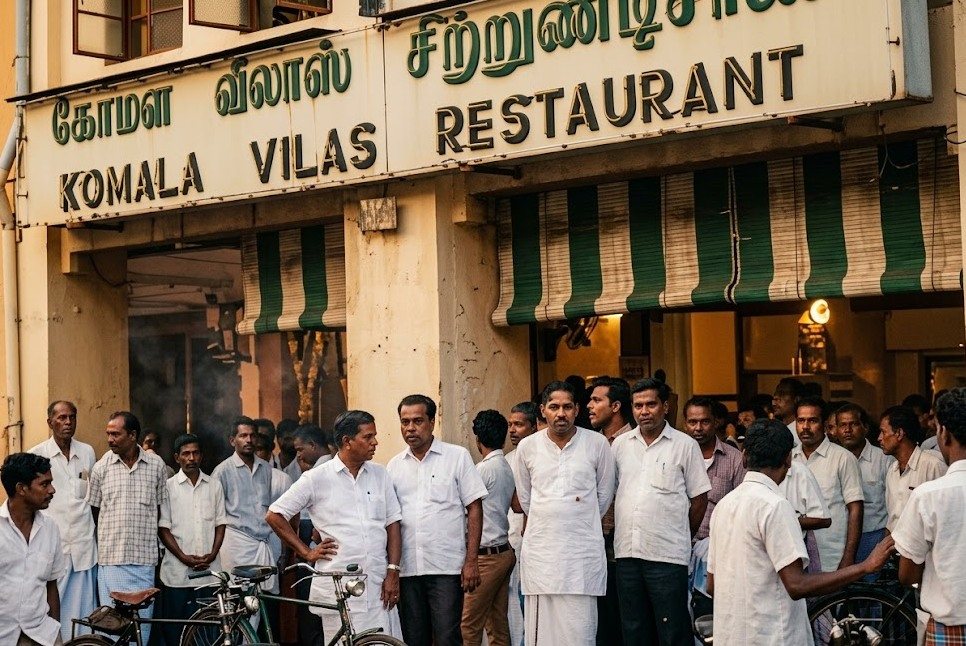
He used what he had saved over the years, supplemented by borrowed money, and renamed it Komala Vilas, after the woman who had shown him kindness when he was a teenager far from home. "Vilas" means home.
The business has traced an unbroken family legacy back to 1947. Seventy-nine years.
Murugiah served what he knew from his roots: South Indian vegetarian cuisine from the Tanjore tradition, including dosai, idli, vadai, thali meals, and strong South Indian coffee. Following Tanjore custom, every meal was served on fresh banana leaves, a practice the family has maintained to this day.
He did one other thing that tells you who he was.
He placed free Indian newspapers and Tamil magazines in the restaurant for his customers to read.
Komala Vilas became something like a dining room and reading room for generations of Little India patrons, a place where the Tamil community came not just to eat but to stay connected with news from home.
The restaurant began at 76 Serangoon Road and expanded into the neighbouring two-storey shophouse at No. 78 in the 1950s.
Over the decades, it became the restaurant that families returned to for every occasion: a child's first taste of proper dosai, a grandmother's birthday thali, a Saturday lunch that hadn't changed in 30 years.
From the 1990s, Murugiah's son Rajoo Gunasekaran took charge, and in July 1995 R.T. Sekar launched a related but separate concept, Komala's Restaurants, serving Indian vegetarian cuisine in a modern self-service format.
In 2015, Murugiah's grandson Rajakumar Gunasekaran became the third generation to lead Komala Vilas, adding North Indian dishes to the menu, and in December 2020 the family opened Fennel by Komala Vilas at River Valley Road.
Three generations, the same stretch of Serangoon Road, and the same banana leaves.
Then, in November 2015, something happened that Murugiah could never have imagined when he was a teenage shop assistant.
During Indian Prime Minister Narendra Modi's official visit to Singapore marking 50 years of diplomatic relations, Singapore's Prime Minister Lee Hsien Loong and his wife Ho Ching took Modi on an impromptu supper outing to Little India. They sat down at Komala Vilas and ate dosai, idli, and vadai in the same restaurant where a teenager had once cleared tables.
The media called it "Dosa Diplomacy." Modi tweeted photographs of the meal.
The restaurant that a grateful teenager had named after his employer's kind wife became the backdrop for one of the most photographed diplomatic meals in Singapore's history.
Murugiah Rajoo was shown kindness by a woman named Komala when he had nothing, and when he had the chance to name his own business he didn't name it after himself.
He named it after her.
Most founders name their businesses after themselves: their ego, their brand, their legacy. Murugiah named his after someone else's kindness, and that kindness has been the first thing every customer reads before they walk in.
If you run a business, the lesson is about the name on the door. Murugiah could have called it Rajoo's or Murugiah's, but he chose the name of the woman who was kind to him as a teenager, and that choice told every customer, before they ate a single bite, what kind of restaurant this was. The name was the brand. The brand was gratitude.
And if you're not a business owner, this is simpler still. A teenage boy was shown kindness by a woman in a foreign country. He repaid that kindness by ensuring her name would be spoken every day for the next 79 years. Two Prime Ministers have now eaten under a sign that bears her name.
The longest thank-you note in Singapore is a name above a doorway on Serangoon Road. It's been there since 1947.