
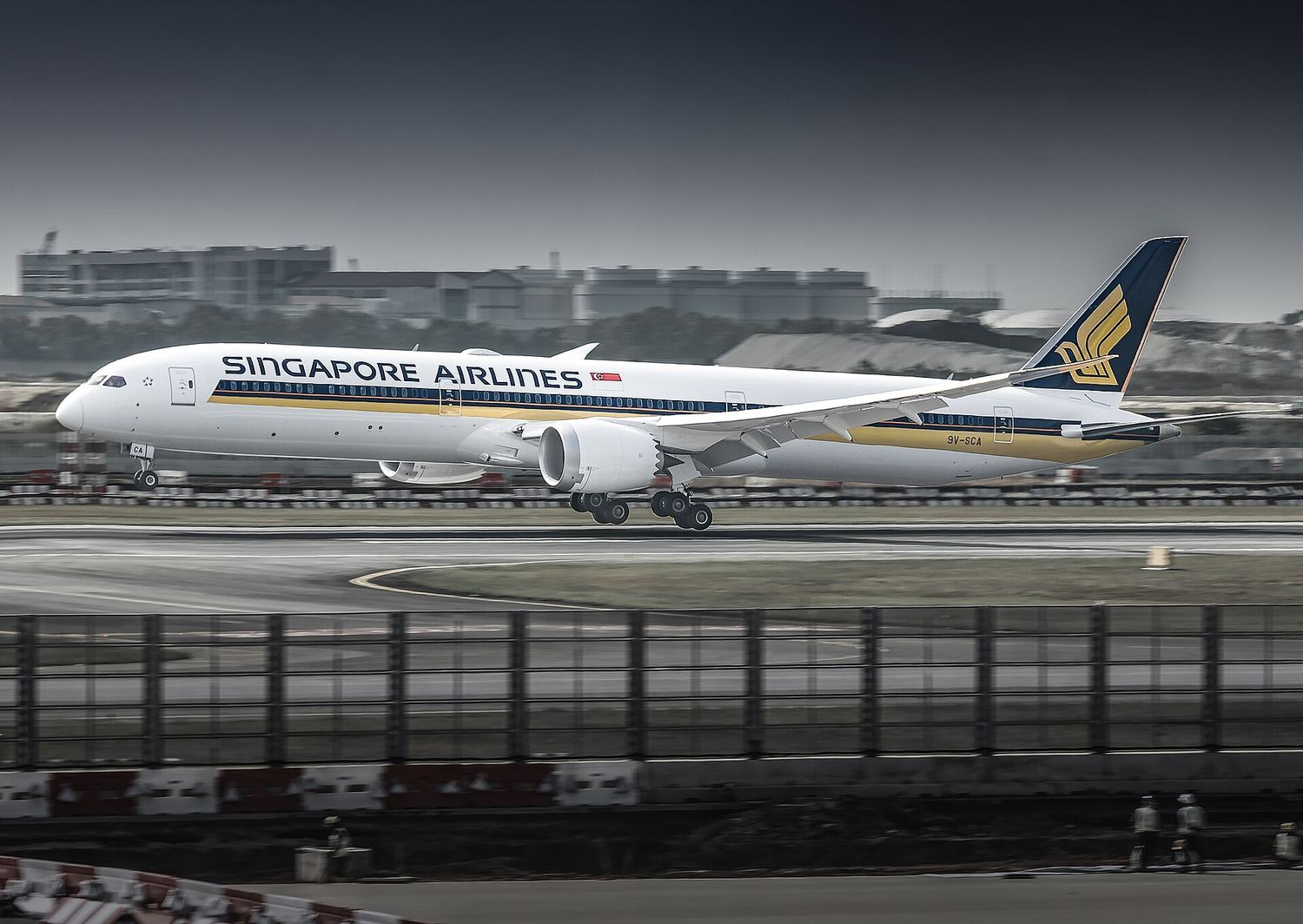

Founders, 21 April 2026
In October 1972, Lee Kuan Yew Told the Staff of a Brand-New Airline Something No Prime Minister Has Ever Said to an Airline Before.
Part me. Part fiction. All love.
3am Stories
In October 1972, Lee Kuan Yew Told The Staff Of A Brand-New Airline Something No Prime Minister Has Ever Said To An Airline Before.
"I set up Singapore Airlines to make profits. If it cannot make profits, I will close it down."
The airline had ten planes.
Twenty-two destinations.
A name that was barely three months old.
And a prime minister who meant every word.
This is the story of how a tiny island with no domestic flights built the best airline in the world. And why it matters to anyone who's ever looked at where they are and wondered if they could reach further.
===============================
Before Singapore Airlines existed, there was Malayan Airways.
It was formed in 1937, on paper, by three companies: British Imperial Airways, the Ocean Steamship Company of Liverpool, and the Straits Steamship Company of Singapore. They had a plan. They had a name. They had a certificate of incorporation.
What they didn't have was a reason to fly.
Another airline, Wearne's Air Service, was already running the only route that mattered, Singapore to Kuala Lumpur.
The first chairman of Malayan Airways, a man named Frank Lane, looked at the numbers and decided the market couldn't hold two carriers. So Malayan Airways did something remarkable for an airline.
It didn't fly.
For ten years.
From 1937 to 1947.
An airline that existed on paper, grounded by a competitor it couldn't beat and a war it couldn't survive.
World War II came. Japan occupied Singapore. Commercial aviation stopped. And by the time the war ended, Wearne's had gone bankrupt.
The obstacle removed itself. Not because Malayan Airways outfought it. Because it outlasted it.
On 1 May 1947, a small plane, an Airspeed Consul, took off from Singapore on a scheduled flight to Kuala Lumpur. Six seats. That was the first flight of what would eventually become Singapore Airlines.
Six seats.
The entire aircraft couldn't carry enough passengers to fill a single row on today's A380.
For the next twenty-five years, the airline kept changing its name because the country it belonged to kept changing its shape.
Malayan Airways became Malaysian Airways in 1963, when Malaysia was formed. Then it became Malaysia-Singapore Airlines in 1966, after Singapore separated. Two countries. One airline. Two governments with different ideas about what an airline should do.
Singapore wanted to go international.
Malaysia wanted to stay domestic.
By 1971, the differences were, in the words of Singapore's Finance Minister Hon Sui Sen, "irreconcilable."
So they split.
And here's the part most people don't know. When they divided the assets,
Singapore got the Boeing fleet, the headquarters, the international routes, and the offices in eighteen countries. It also got a problem nobody else wanted.
Singapore had no domestic market.
Zero.
A country so small you can drive from one end to the other in forty-five minutes.
There was no Singapore-to-Singapore route.
No short regional hops to fill the seats on quiet days. Every single flight had to be international. Every route had to compete with airlines from countries ten, twenty, fifty times its size.
The airline was incorporated on 28 January 1972 as Mercury Singapore Airlines. Malaysia objected to the name, so they changed it. On 27 June 1972, it became Singapore Airlines.
And on 1 October 1972, SIA flew its first three flights.
One to London.
One to Sydney.
And one coming home.
Three flights. Ten planes. Twenty-two destinations.
And a prime minister standing at the inaugural dinner telling a room full of airline staff: make money, or I'm pulling the plug.
That's where most stories would end. Small country, impossible odds, doomed to fail.
That's where this story begins.
SIA didn't compete on size.
It couldn't.
It competed on something else.
In 1972, a small local advertising firm called Batey Ads was given the job of marketing the airline. They had to answer a question that would define SIA for the next five decades: if you can't be the biggest, what can you be?
The answer walked through the cabin door in a sarong kebaya.
The Singapore Girl became one of the most recognised airline icons in the world.
Not because of a massive advertising budget. Because Batey Ads understood something: in an industry where every airline has the same planes, the same routes, and the same sky, the difference is how you make people feel when they're inside the tube.
SIA bet everything on service. On the details. On the things that don't show up in a spreadsheet but show up in a passenger's memory.
And it worked.
By 1973, SIA had its first Boeing 747s.
By the late seventies, it was sharing a Concorde with British Airways on a Singapore-to-London route, the SIA livery painted on one side of the aircraft and BA's on the other.
The route was eventually shut down because of noise complaints and costs, but the point had been made. A twenty-five-year-old airline from an island smaller than London was sharing the sky with the fastest passenger aircraft ever built.
Through every challenge, the pattern was the same.
No domestic cushion.
No fallback.
Every route had to earn its place and every flight had to justify itself. And every dollar spent on a better seat, a better meal, a better smile had to translate into a passenger who came back.
SARS emptied the planes.
SIA survived.
The global financial crisis crushed demand.
SIA adapted. COVID grounded the entire fleet. SIA raised capital, cut costs, and kept the brand intact so that when the world started flying again, the first airline people thought of was the one with the girl in the sarong kebaya.
Today, SIA flies to over ninety cities in nearly forty countries.
It's won Best Airline so many times that listing the awards would take longer than the story. And it all started with six seats on a borrowed plane and a prime minister who said: be excellent, or don't exist.
===============================
I think about that story every time I fly.
But I didn't always.
Years ago, early in my career, I was flying to the US for a business trip.
I booked the cheapest ticket I could find. Cathay Pacific. Economy.
Seat somewhere in the back, the kind of seat where the person in front reclines into your lap and you eat your meal with your elbows pinned to your sides.
I didn't think twice about it.
That's what you do when you're building something.
You save. You cut corners on yourself because the business needs the money more than your knees need the legroom. Economy was fine. Economy was responsible. Economy was what I could afford.
At a dinner that night with a group of business associates, an American guy found out I was from Singapore.
His face lit up.
"Singapore! You fly SQ?"
I shook my head. "Cathay. Economy."
He looked at me like I'd told him I lived by the ocean and didn't swim.
Then he started talking about Singapore Airlines business class.
He talked about the seat.
The legroom. The food. The way the crew remembered his name.
He described the experience the way some people describe their wedding day.
Every detail. Every sensation. The hot towel.
The champagne before takeoff. The lie-flat bed.
And I sat there, picking at my dinner, realising that the airline he was raving about, the one he'd crossed an ocean to fly, was from my country. My tiny island. And I'd never flown it.
And I didn't say anything that night.
But something shifted.
Not the budget.
The budget didn't change for a long time after that.
What changed was the ceiling.
I'd been setting my own ceiling at economy because economy was what I knew. And someone who had nothing to do with Singapore was showing me what Singapore had built, while I was too busy being practical to look up.
But that conversation didn't put me in business class the next flight.
Or the one after that.
It took years.
More work. More building. More economy seats.
But I remembered what that man said. And I remembered what Lee Kuan Yew said.
"Make profits, or I'll shut you down."
SIA didn't have the luxury of a domestic market.
It didn't have the size of American carriers or the legacy of European ones.
It had ten planes and a threat. And it decided that if it was going to fly, it would fly better than anyone else.
I think about that when I catch myself settling. When the safe option feels like the smart option. When "good enough" starts to sound like a strategy.
Because SIA could have been good enough. A small regional airline connecting Singapore to KL and Bangkok. Nobody would have blamed them.
The island is tiny.
The market is small.
"Good enough" would have been respectable.
But they didn't settle. They competed with airlines that had fifty years of history, a hundred times the domestic market, and a thousand times the budget. And they won. Not once. For five decades straight.
That's the thing about ceilings.
Most of them are installed by the person standing underneath them.
Not by the room.
SIA's ceiling was supposed to be a small island with no domestic routes and a PM who'd shut them down if they failed. They looked at that ceiling and flew through it.
Your ceiling might be economy class. It might be a job title. It might be a revenue number, a market you haven't entered, a version of yourself you've been putting off.
Whatever it is, the airline that started with six seats and ended up the best in the world has a message for you.
So don't settle. Don't stay grounded because someone else is already flying the route.
Refuse the seat you're in when you know there's a better one.
Reach for it.
Even if it takes years.
Even if you have to sit in economy for a long time first.
Because one day you'll board that flight. And when you do, you'll know exactly what got you there. The same thing that turned ten planes into ninety cities.
The refusal to be anything less than excellent.
3am Stories. Pass it on.